

A Resounding, Affirming and, to Some, Surprising 2026 Town Election.
But what to make of the silence in the run-up? And the low turnout? A news analysis.
By Geoffrey Gevalt
The Record Managing Editor
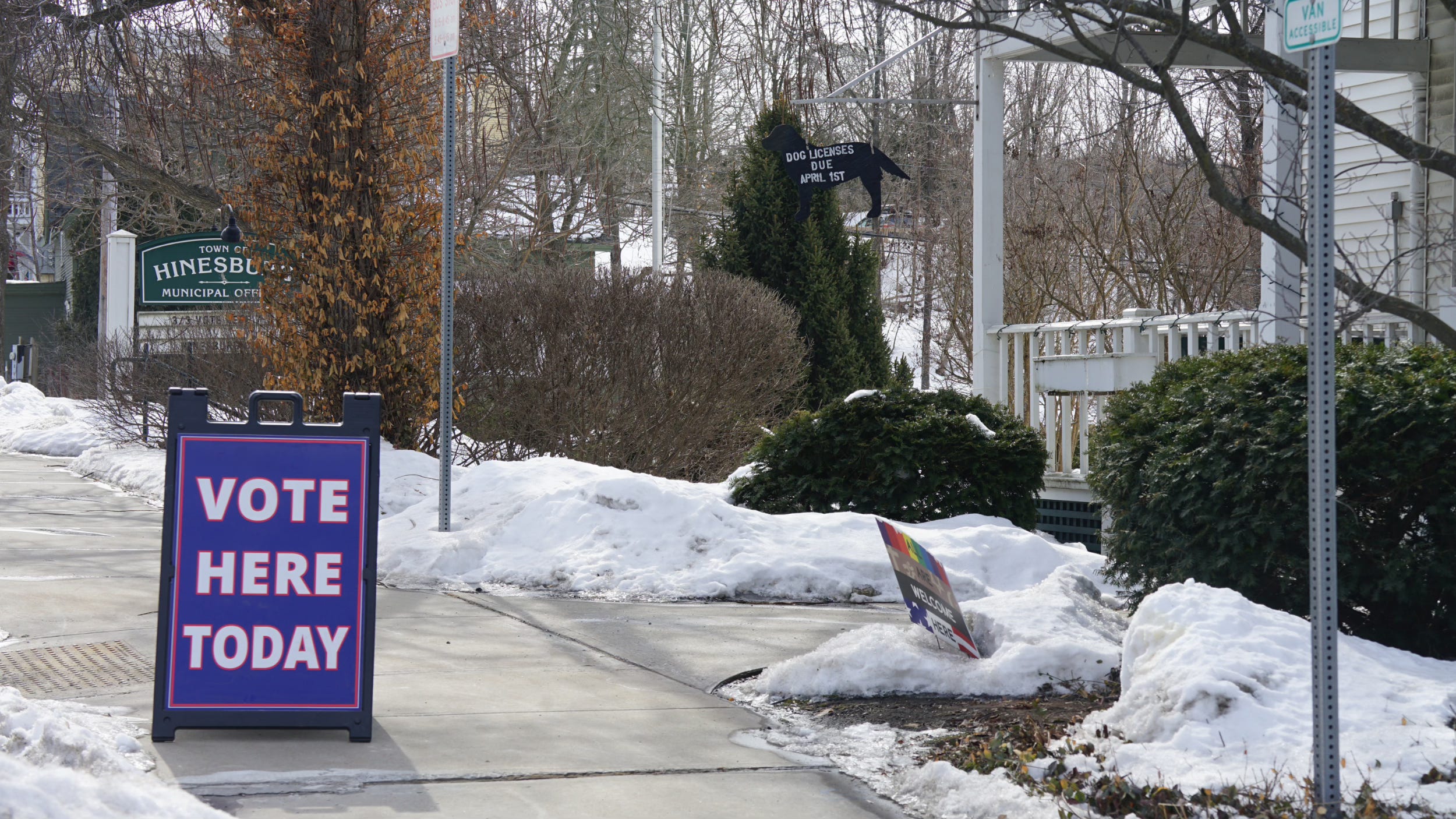
On Tuesday, March 3, voters approved all of the municipal budget items totaling $5.9 million; re-elected incumbent Cassandra Townshend to the CVSD board in the only contested local race; and were part of the five-town school district vote that approved the schools’ $107 million budget by a margin of 2-1.
A total of 1,033 people voted – about 25 percent of the 3,968 registered voters – and the margins of approval were quite dramatic; some were more than 4-1. Also remarkable was what some officials referred to as the “silence” leading up to the vote despite some hefty budget increases in the police and fire budgets at a time when the costs of housing, food and taxes have been rising considerably.

That certainly was on the minds of the CVSD board and the Hinesburg members of selectboard as they worked on the budget in November, December and January. Truth be told, the selectboard members were worried that some of the budget items wouldn’t pass even after they trimmed the total budget to a seven percent increase from the 2025/26 year’s budget.
To understand the vote a little better, The Record spoke to more than a dozen people – town officials, voters and people with many years watching elections and Town Meeting in Hinesburg. Some consistent themes and observations appeared:
Hinesburg tends to support its town officials and budgets. Only the initial 2022 police budget and the 2024 CVSD budget have been turned down in recent years. (Vermont law prevents districts from revealing how each town votes on school budgets, so we don’t actually know how Hinesburg voted on the schools budget in 2024.)
The Hinesburg population is aging so public safety and emergency medical response are of greater interest. According to the U.S. Census, the median age of a Hinesburg resident is now 50 compared to 35 in 2000. Or consider these numbers: 1,629 of the town’s 2,181 households do not have children under the age of 18. Of Hinesburg’s 4,718 residents 30 percent, or 1,661 residents, are over the age of 60.
Median income has also risen dramatically. In 2024 it was $112,539 compared to $49,788 in 2000. Even with inflation that is a significant demographic shift and points to a population less concerned about modest increases in taxes particularly in an environment when everything has gotten more expensive. Another interesting demographic: 20 percent of the 2,181 Hinesburg households are rental units.
For opposition to succeed, it needs to be organized. While a little residual concern about the police department may explain why there were 100 fewer yes votes for the police budget than for the fire department budget, it still passed easily. Historically, there has always been a pocket of opposition towards the police since the first chief was hired in 1994. Further turmoil came in 2010 when that chief, Chris Morrell, was fired. Then came the police budget defeat in 2022, a harbinger of the turmoil that surrounded the departure in January last year of then-Chief Anthony Cambridge and the depletion of the staff after Hinesburg cancelled its agreement to also cover the town of Richmond.
There was only one contested position in this year’s election with incumbent selectboard members unopposed. Without a real race, voting numbers have tended to be low. Even last year, when one selectboard incumbent faced opposition, the total vote was only 200 or so more than this year.
This year’s town budget meetings reflected a thoughtful, concerted effort by Town Manager Todd Odit and Assistant Town Manager Joy Grossman to both highlight the need for more staffing and also work out compromises that the selectboard could embrace.
The Reactions
Reached the morning after the vote, Hinesburg Town Manager Todd Odit was relieved. So was Fire Chief Prescott Nadeau. New Police Chief Chris Romance, however, said the vote simply confirmed what he thought: Hinesburg residents support public safety.
Odit and others on the town staff were also surprised at the wide margins that the budgets were approved by and at the “silence” in the months leading up to the vote: Few attended public budget meetings or even the public forum on public safety; there were few emails or texts or phone calls; they didn’t even hear whispers of opposition in the air.
“Going into [the vote] I had no idea what people were thinking, and how the vote might go … even after the informational meeting, Odit said. “It was the quietest pre-budget-vote I’ve ever experienced.”
Prescott Nadeau, the fire chief, had much the same reaction.
“It was a relief,” he said. He had initially requested two additional firefighter/EMT positions to cover the station 24/7 but trimmed the request to one. He knew it was still a big ask. “I had very little indication of which way it was going to go. I was assuming no news was good news.”
Yet he worried and admitted, “I hadn’t really fully wrapped my brain around what I was going to have to do if it was a ‘no.’ I was really counting on what happened, which was the public showing its trust in us – that we serve them appropriately and that we’d given them … budget numbers that represented what we truly needed.”
Some of the people with whom The Record spoke noted that in their experience it is a rare thing for Hinesburg voters to turn down anything.
Steve Giroux, of Giroux Body Shop, was one who wasn’t that surprised. “People will complain,” he said, “but then they don’t vote.” Those who do vote, he added, are people “who aren’t strapped for money and don’t mind.”
Giroux also noted that the vote represented the continuation of change in Hinesburg: the fire department is going to “more paid people … instead of volunteers,” and the police department is expanding its force. “And I’m sure the next step will be ‘more people for this, more people for that, and we need a new building …’ I don’t see an end to it.
“Nothing is free. It all costs money but working people can’t afford it; and there are not a lot of deep pockets out there.”
Almost to prove his point, one voter, who asked that his name not be used, said “I only voted for the library. I said no to the rest.”
“Why?” he was asked.
“Government is too damned expensive.”
Another said that it was beyond him as to how the CVSD school board “could not find some way to cut a $107 million budget. … Particularly with declining enrollment.”
Lynn Gardner, owner of Clifford Lumber and a former selectboard member, said in his day, “we had years we were concerned as to whether the budget would pass, but when it came to town meeting everything passed rather easily. People grumble, but all in all it seems the town’s citizens pretty much support the selectboard and the schools.”
But Gardner – and others – lamented the loss of the traditional Town Meeting and felt that eliminating it took away an opportunity for voters to participate and to argue for a change. Instead, they cast their ballots in silence.
He admitted that for most people the budget process “is a little boring and a little hard to understand,” and that people don’t have the time to follow the intricacy of the process.
Chuck Ross, former Vermont Secretary of Agriculture, state representative and aide to former Senator Patrick Leahy, noted the phenomenon that people tend to complain about Congress but then quickly add that their own congressperson is good. “People tend to feel they know the local government and trust them and support them when there is no articulated grievance.
“People also tend to vote for their personal interests, what they think will help them.”
Ross agreed with Gardner regarding Town Meeting saying that ending it “disenfranchised” voters. He also noted that we are all getting deluged with information in our emails and on the internet and are less inclined to seek out sources of local content.
Merrily Lovell, the chair of the selectboard, said she, too, was surprised. All of the board members, she said, were worried about the mood of the voters. Board members Dennis Place and Paul Lamberson were particularly vocal about needing to trim the budget as it was initially proposed. Place was concerned that the budget was “spending money we don’t yet have.” Lamberson and Place were concerned about heading to a “career fire department” while board member Mike Loner argued that the era of volunteer fire departments was over.
Editor’s Note: Loner contacted The Record after this story was published to say his position needed clarification.
“My comments [about voluntarism] were in response to another board member arguing that we should get more volunteers, and I was alluding to the fact that fire departments across the country are struggling to do that. I was not necessarily arguing that the town should move to a “career fire department” as the sentence implies.
“My take on it is that securing enough volunteers to run an efficient department these days is difficult, but that does not mean we scrap the volunteer model and become a full-time staff model. There should be a blending of the two; we need to find the middle ground given budget constraints, staffing needs and volunteer scarcity.”
It should be pointed out that at that same meeting that Loner did in fact say much the same thing, Fire Chief Prescott Nadeau said that is his exact strategy.
That snippet of the back-and-forth was representative of the course of back and forth that occurred at many of the selectboard meetings that The Record covered. What was most noticeable was the civility with which the selectboard and Odit worked on compromise and a final budget that was eventually heartily embraced by the voters.
Several of the people who didn’t want to be named in this article noted that. “I think we just trust that the town officials and departments are doing their jobs.”
The only question is, what did the other 75 percent or so of the town’s voters think? And why didn’t they vote?
Note: A big thanks to Town Clerk Heather Roberts who supplied The Record with the results the night of the election and with numerous historical numbers which helped this report.
Great article, Geoff. Especially liked the cast of sources. And of course the underlying question about how democracy is working. The relevant motivational quote going around seems to be from former Congresswoman Barbara Jordan: “If you’re not at the table, you’re on the menu.” A tough message, but the best push I’ve heard to VOTE. Thank you for all your work.
Distant Neighbor
This is a great article and message. Always curious how to get more engaged and how to engage more people. This is a start.