

As Winters Get Warmer, Maple Farmers are Learning to Adapt
Producers adopt new methods as climate change disrupts sugaring season.
By Indi Rose
Via Community News Service, a University of Vermont internship program
Sugar maples are called “Goldilocks” trees for good reason.
Preferring temperatures to be just right, the trees produce more sap over freezing nights and on days that are just warm enough.
But warmer winters and midseason thaws are disrupting that balance. Producers are being forced to adapt to protect both their trees and their livelihoods.
“The recent winters have warmed up way too fast to have much of a maple season,” said Matt Paggi, co-owner of Barred Woods Maple in Johnson.
Paggi said his maple trees are resilient, but not indestructible.
“We’re lucky so far. Hopefully the weather won’t keep getting warmer,” he said.
Maple syrup is a wild crop, which is rare for a major agricultural product. Having a successful season hinges on the health of an entire forest ecosystem. When that ecosystem shifts, so does the harvest.
When maple trees get cold, they produce a surplus of sugar to protect their cells from damage, acting as a sort of anti-freeze, according to Dr. Tim Rademacher, director of scientific research at the University of Vermont’s Proctor Maple Research Center.
Therefore, the colder the winter, the sweeter the sap in the spring.
“We have only a handful of events per year where we make most of our crop, and that’s purely weather driven,” Rademacher said.
Over the past three decades, winter temperatures in the Northeast have risen faster even than average temperatures in the U.S., according to climate data from the National Oceanic and Atmospheric Administration.
This results in an earlier season that ends abruptly and can be punctuated by stretches that are simply too warm.
In Vermont, prime sugaring season has moved earlier, Rademacher said, to February and March, when it used to be April and May.
In addition to shifting weather patterns, invasive species are a growing concern. The emerald ash borer, which has decimated major parts of northeastern forests, has been destructive to the ecosystems that sustain sugar maples.
To adapt to these changes, farmers are turning to new technology. Reverse osmosis machines remove a significant portion of water from the sap before it’s boiled, cutting down on the farmers’ labor and fuel costs. The technology has allowed farmers to scale up production and buffer against increasingly erratic seasons.
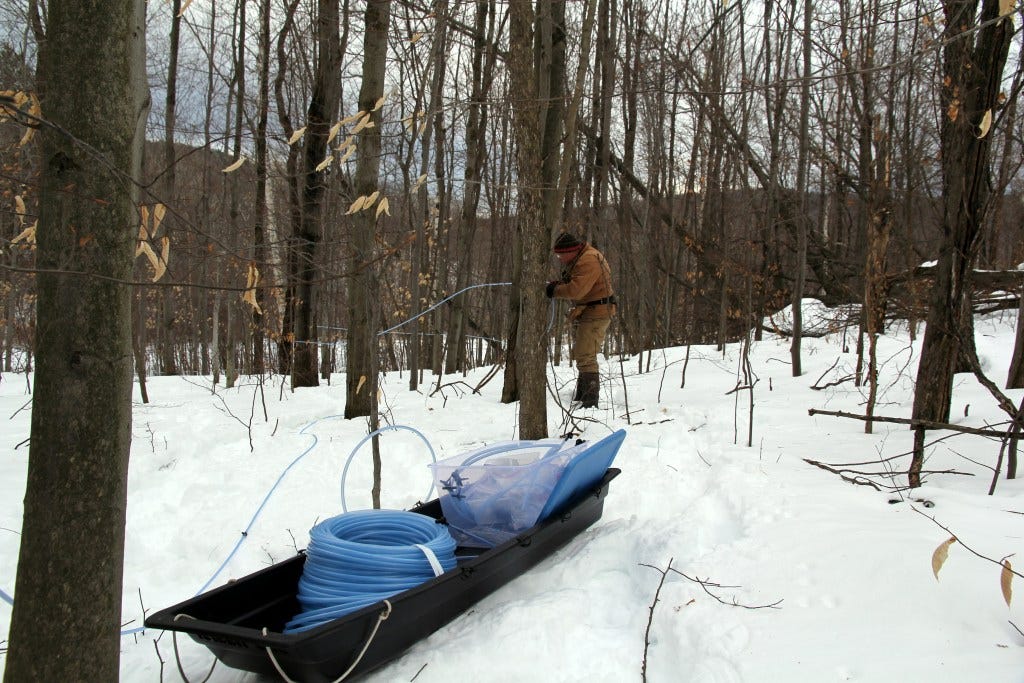
To keep pace, Vermont’s sugar forests look different now. Modern tubing systems weave through sugarbushes where buckets once hung. Farmers are digging deep channels through their soil to guide rainwater and mitigate erosion and carefully logging and cutting diseased trees.
For many producers, those investments come at a steep cost.
“It’s definitely tough,” Paggi of Barred Woods Maple said. “It’s made the business unpredictable.”
Groups such as the Vermont Maple Sugar Makers’ Association have stepped in to help. In 2022, former U.S. senator Patrick Leahy secured more than $600,000 in federal earmarks to help farmers offset their production costs.
The association has since awarded $475,000 in grants for sugaring equipment, materials to test syrup for allergens and other items, said Allison Hope, executive director of Vermont Sugar Makers’ Association.
“For some organizations, that amount of money might not be a lot, but when we’re giving it all back to producers, that’s a lot,” Hope said. “It’s huge, and it’s meaningful.”
But the money is due to expire in October 2027. And with President Donald Trump’s administration cutting back on research funding, it’s unclear if the state will be able to fund such projects.
In the meantime, Hope said Vermonters can support their farmers simply by eating more maple syrup. They’ll have the chance to do so at Maple Open House Weekend, the state’s annual celebration of sugaring, scheduled for March 21 and 22.
“If people used one to two more tablespoons of maple syrup every day, your wallet really wouldn’t notice that difference, but farmers would,” Hope said.