

CVSD Board Votes for Artificial Turf
In tense, lengthy meeting board agrees to pursue a "gift agreement" with the donors of a proposed turf field, bleachers, lighting, concession stand, bathroom and ADA accessibility at CVU.
By Geoffrey Gevalt
Hinesburg Record staff reporter
In the end, the opponents’ case didn’t stick.
After hearing dozens of opponents talk about the dangers of artificial turf fields to human and environmental health and after hearing a hydrogeologist explain that runoff from the field presented little risk to Hinesburg wells, the CVSD board voted 8-3 to move forward on a $6 million gift of an artificial turf field and athletic complex at CVU.
The district will now iron out an agreement with the donors – The Community Field Project group led by Eli Lesser-Goldsmith – which will be made public once it is completed, according to Supt. Adam Bunting. The project itself will move forward once money for the project has been raised.
More than 60 people attended the meeting in person and another 40 on Zoom. Most were opponents of the plan. Proponents were scarce, but district officials contended that they might have been worried that the meeting would get tense. It did.
In two public comment periods, one at the beginning of the meeting and one after a presentation by a hydrogeologist hired by the district and a nearly two-hour executive session immediately after, mostly Hinesburg residents:
presented the board with a list of nearly 1,000 people who had signed petitions opposing the proposed artificial turf field;
reminded the board that the Hinesburg selectboard, conservation commission and planning commission as well as the Charlotte Conservation Commission had written letters of concern and/or opposition;
pointed out that the Waite Heindel hydrogeology study of potential risk to wells was at best, severely limited, and at worst, flawed and incomplete;
there was no proper accounting to determine how much the district – and voters – will have to pay down the road for disposal; and
wondered why the district would put 2.2 acres of plastic on a field at a time when more and more evidence is emerging on the health dangers for student athletes.
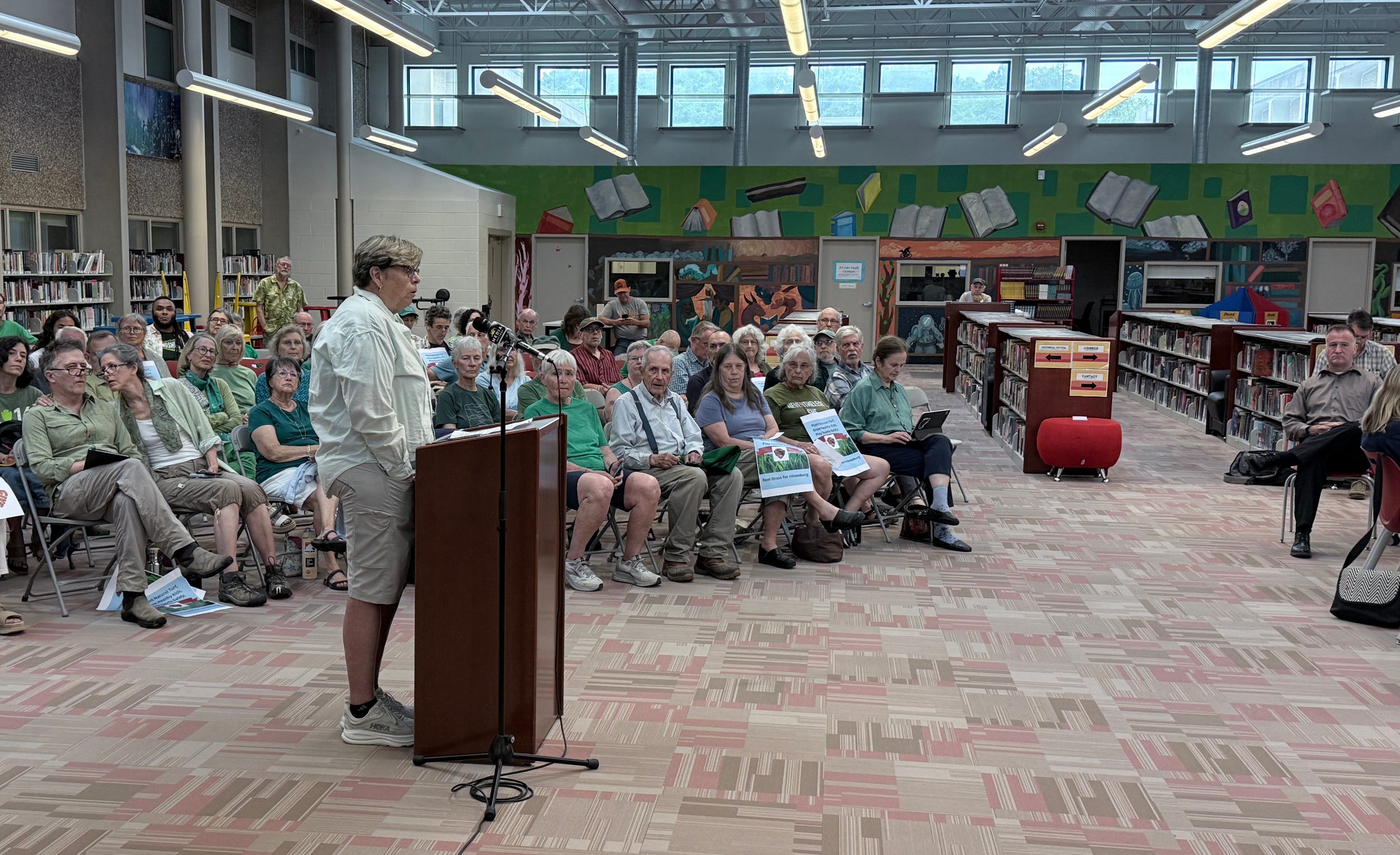
Geri Knortz, a Hinesburg resident and retired athletic director at St. Michael’s College, covered many of the issues in her two minutes of allowed comment:
“I am well aware of the appeal of a turf field for convenience and durability. However, many of us continue to believe there are undeniable reasons to reject turf.
“Artificial turf exposes athletes to known carcinogens as well as hormonal and endocrine disruptors. Cancer, bone health and neurotoxicity for our young adult users are of primary concern. Increased injury rates, ACL knee injuries, turf burns, bacterial infections like staph and MRSA make this such a highly undesirable surface that virually all professional sports associations have banned it.
“Most compelling – PFAS and other forever chemicals,” Knortz added. “No product sample has been, nor are we told will be, submitted for analysis despite numerous requests for such. There is a known link of PFAS to cancer, fertility issues and birth defects and remediation costs millions.
“We, the people, do not feel as if our questions and requests have been heard. The board has not publicly acknowledged nor replied to our legitimate concerns, yet seven of you will soon make a momentous, premature decision that, if in favor of artificial turf, will have catastrophic consequences for our town of 4,500.”
What the crowd may not have realized that this “discussion” about the artificial turf has been going on since the spring of 2025 when Lesser-Goldsmith, part-owner of Healthy Living, went to the district to propose the idea of a privately financed artificial turf field.
The rationale was simple: twice district residents had voted down proposals to install a turf field financed with public money, but there was a need for a better field so that practices wouldn’t be cancelled or moved to another location in the early spring and late fall. Further, an artificial field with proposed ADA access, bleachers, lights and a concession stand would make the field suitable for playoffs and rentals to other athletic groups. More students would use the field more often. CVU would have an athletic complex, they said, they could be proud of.
So Lesser-Goldsmith was scratching an itch that had long bothered CVU and district leaders as well as coaches and students. He held discussions with parents, athletes and coaches and the consensus was a better field was essential and an artificial field would be the best option.
The support has long been there. And it’s still there. Bunting said that letters to the district have been running three-to-one in favor of the project.
But maybe not in Hinesburg.
Over the last two months hundreds of Hinesburg residents have written the board and dozens upon dozens have spoken out at the only two public meetings on the issue – politely obeying the two-minute restrictions and asking the board to consider all the facts. Their passion and conviction have been obvious. So much so that on Tuesday night, one person even broke out in tears.
But the opponents frustration has also come through, particularly in the confusion over exactly what would happen – and what role the public audience would have – at the meeting. The clamor broke out after Chandler Noyes of Waite Heindel Environmental Management had presented the results of potential water contamination, which his firm put at “very unlikely.”
But questions abounded. In stories in The Record, posts on Front Porch Forum, citizens, some with scientific backgrounds, said the study was limited at best and flawed and misleading at worst. They noted that it was done in a little over a month, involved no test borings and cited an incomplete list of research on the dangers and patterns of PFAS spread.
(Editor’s note: The original paragraph below was incorrect. The paragraph below has been edited and is accurate.)
The firm noted that it has studied the issue of microplastics. As turf fields age, the firm noted, the material breaks down into micro- and nanoplastics that are known to disperse through runoff and air transmission and are also known health hazards. The firm’s report included review of relevant scientific articles that have evaluated microplastics. Noyes noted that they “may end up in stormwater and thus the stream downgradient. … Our conclusions were that it would be less likely but still possible for microplastics to end up in Hinesburg Town Well 4, but because there are no state or federal standards at this time and none expected for one or more decades, there are no current regulatory implications.”
But the board had heard enough. Or so it appeared.
Williston school board member Erin Henderson clearly had had enough. She turned to address someone in the audience who’d interrupted the board to ask the board why it was going into executive session to discuss the issue and why the public was not able to ask questions of the hydrogeologist.
Henderson turned in her chair and said, “You are being very rude. We understand your passion, but you make assumptions that we have not done research, we have not read the hundreds and hundreds of comments. We understand. We are volunteers and we are elected officials and we have spent so much time on this.”
“And you won’t let us ask questions,” a woman shouted.
“We are trying to follow the open meeting laws. But how many times do you say the same thing? We’ve heard it. We’ve read it.”
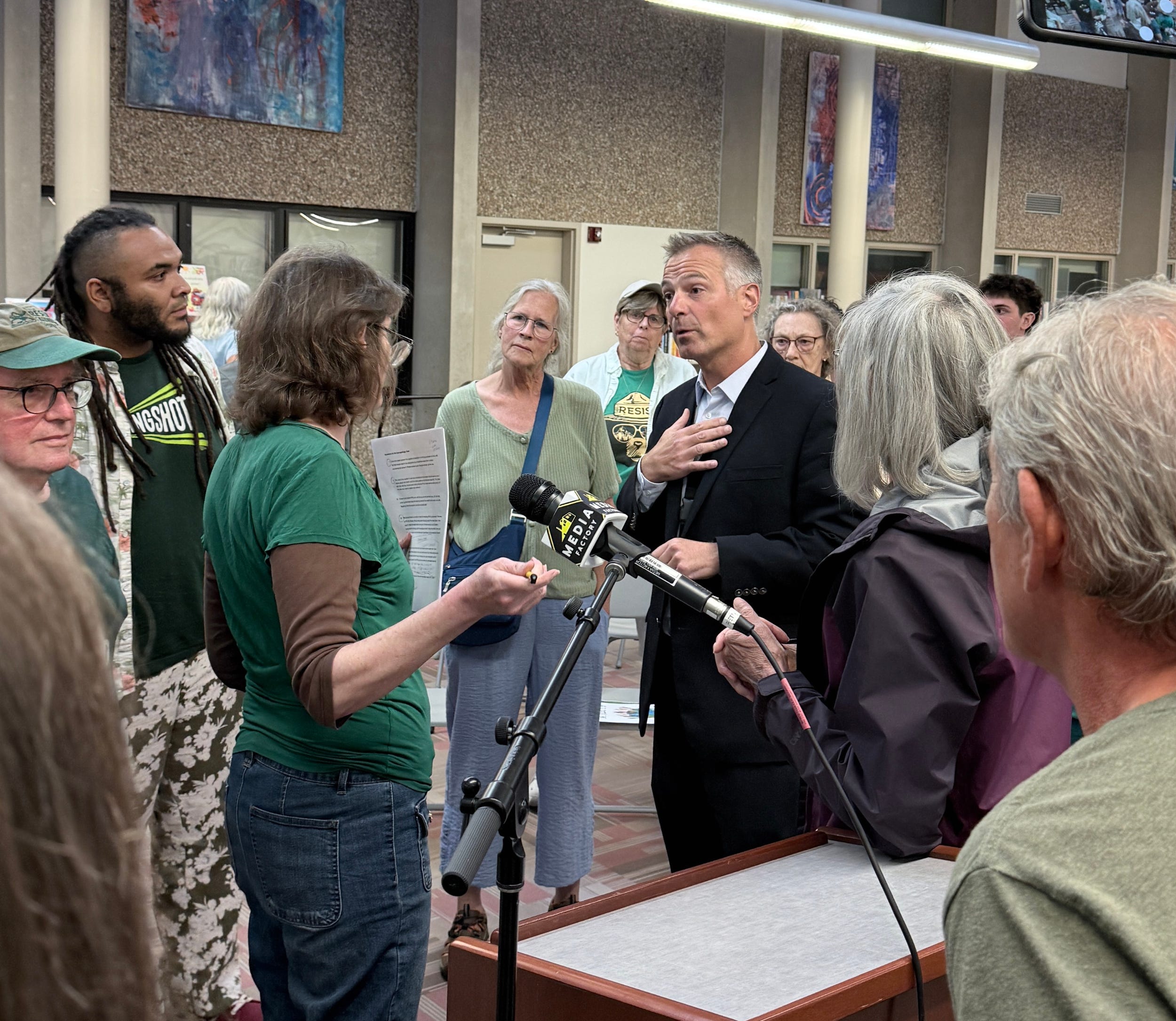
Bunting, superintendent of the CVSD, admitted later that the board should have explained their process better so there wouldn’t have been quite such a disconnect.
Afterwards, Hinesburg residents at the meeting said they felt disrespected, that their opinions and work were not heard. Bunting, while not at liberty to discuss the executive session, said that the opponents’ testimony was heard and was discussed. And the board’s executive session lasted nearly two hours.
After the board returned, board chair Meghan Metzler asked Hinesburg’s representative on the board, Keith Roberts, to make his motion to enter into a memorandum of understanding with the turf field donor group. A public comment period was opened for another 45 minutes of residents expressing their concerns, opposition and entreaties for the board to vote ‘no.’
Jennifer Decker, a Hinesburg resident who’s spent countless hours opposing the project because of, among other things, her concerns over PFAS (forever chemicals) and micro- and nano-plastics, presented the board with a roll of paper listing nearly 1,000 names of Hinesburg citizens who’ve signed petitions opposing the field.
Only two urged them to vote yes.
Senior student body president Alex Jovell said the student body was overwhelmingly in support of an artificial turf.
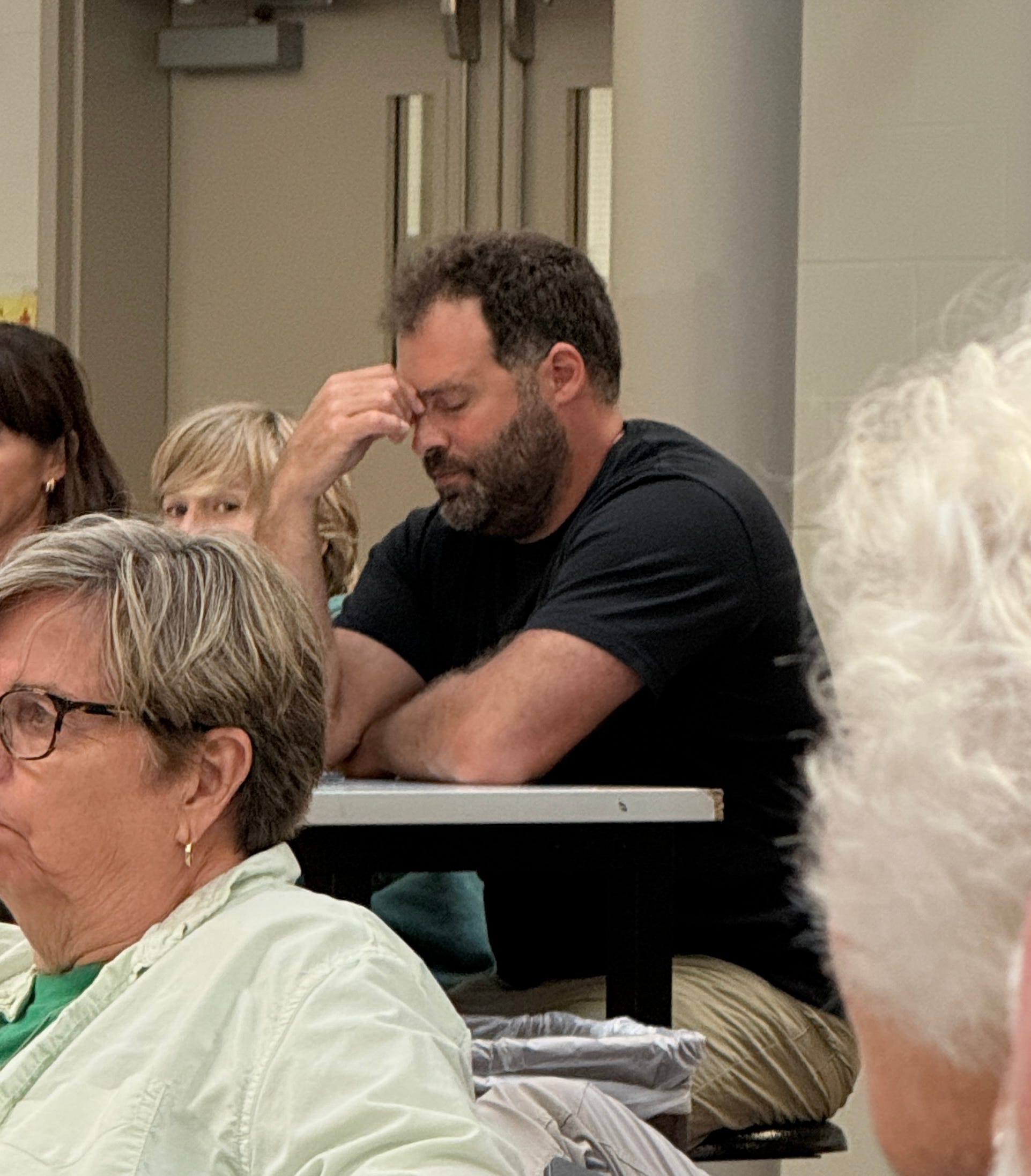
Lesser-Goldsmith spoke briefly saying the intent of the project was to deal with a student need and “to bring the community joy.”
But as Mary Beth Bowman said a few minutes later, “there is no joy in this room.”
From Zoom, Rep. Angela Arsenault, a former member of the district school board, said, “I fully acknowledge and believe that everybody involved here is working toward what they believe to be the best interests of our students and our communities.
“I just want to speak to the wisdom of opening the district up to what is all but guaranteed to be litigation,” she added. “So at a time when public trust in our district is more important than ever, I really caution the board and hope you’ll consider voting no.”
After the public comments, Metzler had a revealing statement prior to the vote: reading something that clearly had been discussed in executive session and was part of the memorandum of understanding that the district is working out with the donor group. She may also have been trying to offset reporting of Lesser-Goldsmith’s dictum in response to a board member’s question at its May meeting that the district would have input, “but no veto power.”
“This district is not giving up control of the project or decisions made on district property,” Metzler said. “The district will be the applicant or co-applicant for required local and state permits, if we agree with this, as appropriate and will review, approve and execute design submittals, permit applications and procurement recommendations.
“The district will have final approval over all phases of project design, permit submittals, contract awards, construction scheduling and others. The district shall have direct oversight and authority rewgarding any on-campus activities and the donor shall structure and conduct procurement for the project consistent with any district procurement policy.”
The board then voted, with Metzler abstaining, to enter into negotiations to develop a memorandum of understanding with Lesser-Goldsmith and his group to move forward to accept their $6 million gift to build a new field and athletic complex.
Voting for: Roberts, Cassandra Townshend (Hinesburg), Erika Lea (Shelburne), Kate Webb (Shelburne), Jean Sanchez (Williston), Henderson, Brendan McMahon (Williston) and Meaghan Siket (Charlotte). Voting against: Dave Connery (Shelburne), Lindsay Colf (St. George) and Sarah Showalter-Feuilette (Williston).
And with that, the crowd – with a few shouts and “see you in court” – and the board filtered out into a deluge; thunderstorms had rocked the meeting for much of the night.
Thanks so much for giving us factual information and so much flavor that we could have a sense of the meeting..
Very well written Goeff. Sounds like a very intense night