

Hydrogeologists See Little Threat of Contamination from Proposed CVU Turf Field
In a report given to the CVSD on Thursday, the Burlington firm concludes that composition of soil, underlying bedrock patterns and planned stormwater mitigation will keep Hinesburg water safe.
By Geoffrey Gevalt
Hinesburg Record staff reporter
CVSD got its answer on Thursday: The proposed artificial turf field at Champlain Valley Union High School in Hinesburg is unlikely to cause any contamination of Hinesburg’s primary source of water.
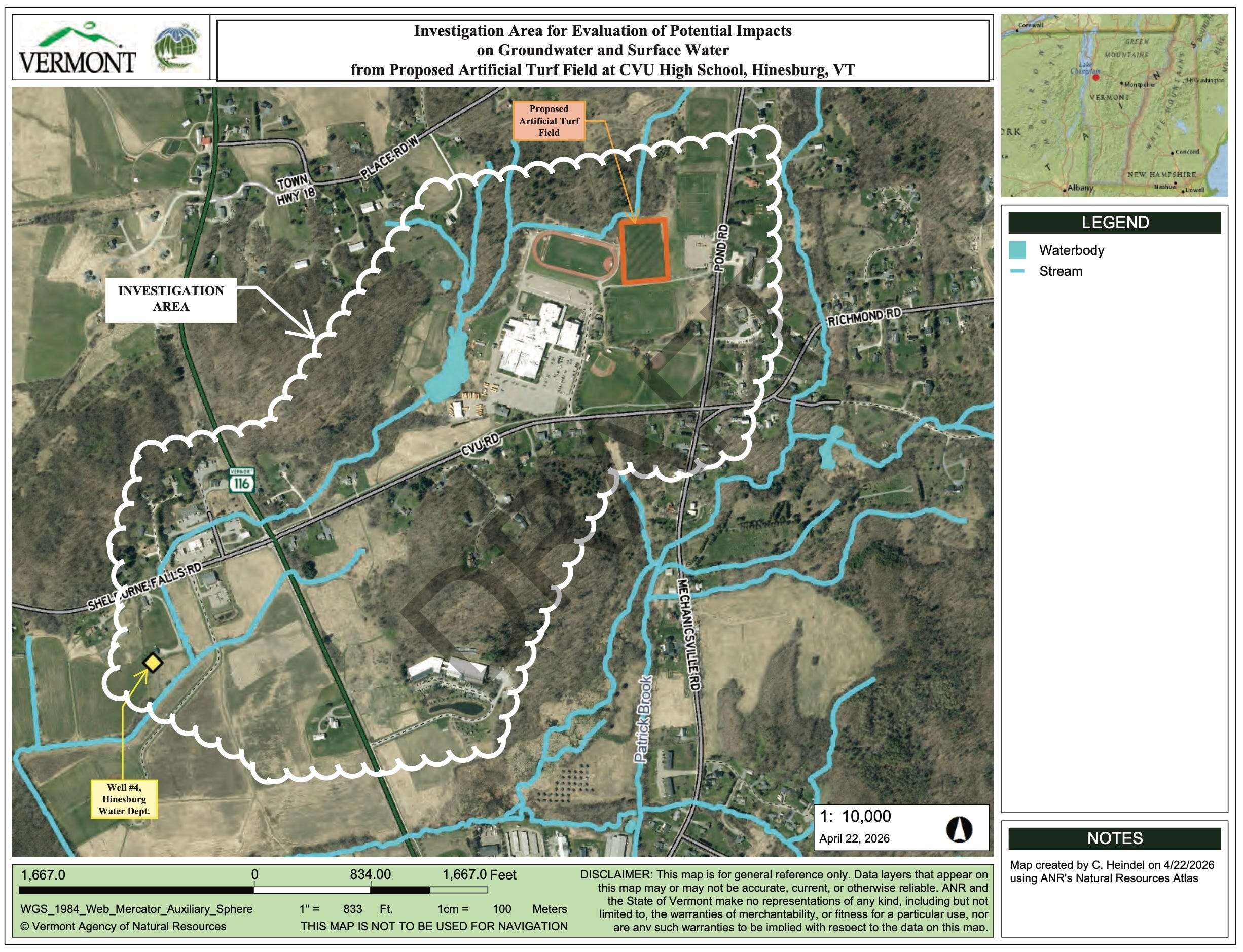
In its 91-page draft report released to The Record (and attached below), Waite Heindel Environmental Management said: “There is very little likelihood that the proposed artificial turf (AT) field at Field B at CVU high school will cause detectable levels of PFAS in Hinesburg Well 4, let alone levels that exceed the current state and federal drinking water standards for PFAS.” PFAS are known as “forever chemicals” which are present in plastics.
Its other conclusions:
“If PFAS is detected in the future in Hinesburg Well 4, it would be unlikely to be able to ascribe its source as an AT field at CVU, given the low permeability of the underlying silt-clay soils, the upward gradient of groundwater from the bedrock aquifer, and the proposed improved stormwater management system.
“Microplastics are likely to be released by wear-and-tear from an AT field at CVU. The proposed improved stormwater management system is likely to capture some MPs, but the current state of knowledge about MPs means that the degree of capture is not predictable at this time.
“There are no drinking water standards for MPs, and we do not anticipate federal or state drinking water standards for MPs for one or more decades – so the regulatory impacts on Hinesburg Well 4 from MPs in general are unknown.”
CVSD Superintendent Adam Bunting, in releasing the report to The Record, said the district is making an effort to be “transparent” but declined to provide a specific comment since he had just received the report and wanted to spend time studying it.
Eli Lesser-Goldsmith of Charlotte is leading the group proposing the $6 million, privately-financed, artificial turf field, grandstand, lighting, concession building, bathroom and ADA access. He could not be reached for comment.
The Hinesburg Planning Commission, meanwhile, sent a letter to the CVSD board outlining its concerns with the proposed artificial turf field and noting that the project faces numerous required permits and public hearings should the board vote to accept it. (Letter below.)
Jennifer Decker, a member of the Commission who has recused herself from the discussion because of her opposition to the turf field, said she was looking through the report and would issue a statement later.
Craig Heindel, one of the principals of the Burlington environmental firm hired by the district, will be making a formal presentation of the study at the CVSD board meeting next Tuesday at 6 p.m. at the CVU library. Bunting said it was possible that the board could take a vote on Tuesday but there would be time set aside for public comment both before and after the presentation.
The study was begun on May 11 at the request of the CVSD board. The work included CVU site visits; interviews with CVU personnel familiar with the field in question (Field B, which is diagonally behind the oval track and has had a notorious drainage problem); review of studies of Hinesburg’s Water Source Protection report (also attached below); review of scientific literature related to artificial turf fields, PFAS and micro-plastics; interviews with personnel in environmental agencies in Vermont and New Hampshire; and interviews with neighbors of CVU with wells.
The study focused on Hinesburg’s primary water source, Well 4, which is located off Shelburne Falls Road and is approximately 4,000 feet from CVU. It was not clear why Well 6, located at the Haystack Crossing development and due to come online in early winter, was not part of the study. (FYI, Well 5 was taken offline several years ago after contaminants leached into the water from the old gasoline tanks in front of Lantman’s Market that have since been removed.)
However, Hinesburg Town Manager Todd Odit told The Record that Well 6 is not in the source protection area. “The greatest threat identified in the Well 6 source protection area plan is the contamination from Lantman’s.”
Here are some of the technical findings summarized in the Waite Heindel report:
Soils at the site are low-permeability silts derived from lake bottom sediments of Glacial Lake Vermont. Soil depths over bedrock at Field B are not precisely known; bedrock outcrops are seen a few hundred feet north and west of the field. However, if the thicknesses of the low-permeability silts under Field B are substantial, they could provide significant protection from potential contaminants from an artificial turf field at Field B.
Data from nearby well logs and descriptions by CVU personnel indicate the likely presence of an upward gradient in the groundwater beneath Field B. This would impede contaminants from penetrating into the underlying bedrock aquifer, and provide substantial protection to nearby private water wells and to Hinesburg Well 4.
Studies at various locations in the U.S. and Europe indicate that artificial turf fields could be sources of PFAS and microplastics in the environment, via stormwater discharges.
Due to the ubiquitous nature of PFAS, their levels identified in artificial turf field materials and related stormwater discharges are generally similar to background levels that exist in the environment.
Specifically related to the AT field proposed at CVU, our worst-case scenario calculations indicate that it is unlikely that PFAS from the artificial turf materials in the proposed field at CVU will cause the concentrations in Hinesburg Well 4 to increase to a detectable level, let alone reach the current Vermont and federal drinking water standards.
Regarding microplastics, the current assessment of the rates, fate, transport – and importance – of potential releases of microplastics is limited. Microplastics levels released from artificial turf fields depend on variable factors, such as physical stress/wear placed on the field and environmental impact to the field.
Specifically related to the artificial field proposed at CVU, the current stormwater management system is likely to capture some of the microplastics released from the artificial turf field, and the proposed stormwater collection and treatment system for the field will likely treat stormwater to a greater degree than the existing system. It would also likely require that the current stormwater management system (and its state permit) be updated.
There are no drinking water standards for MPs, and we do not anticipate federal or state drinking water standards for MPs for one or more decades – so the regulatory impacts on Hinesburg Well 4 from microplastics in general are unknown.
In making its general conclusion that it would be unlikely the proposed field could contaminate Hinesburg’s water, the Burlington firm wrote this about a worst-case scenario:
“In order for PFOS [the most common PFAS compound] in Hinesburg Well 4 to exceed its drinking water standard, approximately four percent of the entire mass of PFOS in all of the grass blades would need to leach from the field and reach Hinesburg Well 4 in a single day – AND that this leaching would continue for approximately 26 more days. After this 27-day period, all of the PFOS would be leached out from the grass blades (1.4 mg/day of released PFOS, times 27 days of release, equals 37.7 mg of PFOS available from the proposed artificial field). From that time going forward, the PFOS concentration in Hinesburg Well 4 would decline back to its current non-detected level.”
The firm added that currently Hinesburg’s water has no detectable PFAS in the water.

We've been told by The Hinesburg Record (I assume the text was written by the Hydrogeologists) that they reviewed the scientific literature on artificial turf fields. I'd like to see their bibliography and whether it included this review article: Ryan-Ndegwa, S., Zamani, R., & Martins, T. (2024). Exploring the Human Health Impact of Artificial Turf Worldwide: A Systematic Review. Environmental Health Insights, 18, 11786302241306291. https://doi.org/10.1177/11786302241306291
It concludes that: we don’t know enough yet to say artificial turf is safe, so it’s a good idea to wait and do more thorough research before putting in more of these fields
Review articles like this are valuable contributions to the scientific literature that help researchers understand the bigger picture. A review article is a comprehensive report that brings together and compares the results from many scientific studies on the same topic. Instead of reading each study individually, a review gathers all the available information, examines how the studies were conducted, and explains what the overall findings mean. This is especially important because it makes complex scientific information easier to understand for people who are not experts. Review articles show where most studies agree and where they differ, helping readers see the bigger picture.
One key reason review articles are valuable is that they help build confidence in the results. When different studies use various methods but still reach similar conclusions, it suggests that the findings are solid and reliable. Using multiple methods reduces the chance that the results are due to mistakes or biases, because if different approaches point to the same outcome, it strengthens the evidence. On the other hand, if results vary depending on the method used, the review highlights this inconsistency and indicates that more research is needed.
The review article by Ryan-Ndegwa, Zamani, and Martins (2024) looks at many studies about artificial turf and its possible effects on human health. They found that the current evidence is not clear enough to say for sure whether artificial turf is safe or harmful. The chemicals in the turf, like heavy metals and other substances, could potentially cause problems, but the levels people are exposed to are usually low.
Because of this uncertainty, the authors recommend being cautious. They suggest that it might be better not to install new artificial turf fields until we have more solid information from long-term studies that carefully measure how much people are really exposed to and what health effects might happen over time. They also stress the need for better and more consistent research methods.
In simple terms, the review says: we don’t know enough yet to say artificial turf is safe, so it’s a good idea to wait and do more thorough research before putting in more of these fields, especially since children and athletes spend a lot of time on them. This cautious approach helps protect people’s health until we have clearer answers.
Who paid the consulting firms fee? This isn’t just some snarky comment. I worked for many years as a highly paid consultant and let me assure you, our firm always concluded what the client wanted us to conclude. Just tell me, who paid these consultants?