

Jailbreak in Springtime
Life on the Head of a Pin: Our columnist describes the challenge – and joy – in finally getting outside aboard a 375-pound electric wheelchair.
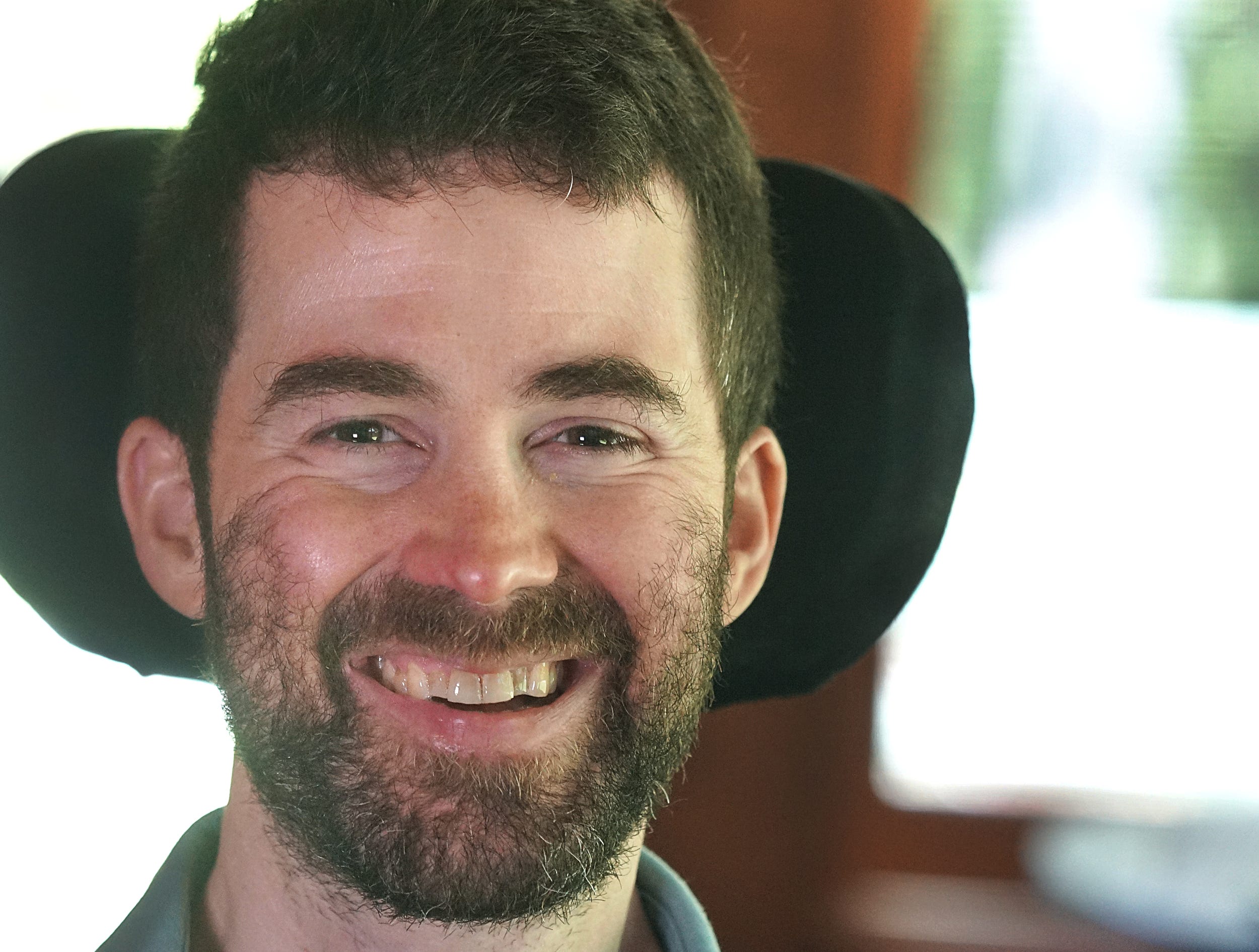
(Editor’s note: Today we begin a regular column, “Life on the Head of a Pin.” The author was diagnosed with amyotrophic lateral sclerosis (ALS) nearly 15 years ago. He writes about his life and its challenges every first and third Thursdays. A Hinesburg resident, he currently serves as a mentor at Hinesburg Community School. To read his other columns, click here.)
By Nate Methot
For the Hinesburg Record
I exist in two rooms. Mostly just one. My life is that small. Shockingly small.
The rooms are not mine; they were assigned to me and, perhaps, I’m lucky to have two. But after five months of gray, of snow and rain and wind and cold, one of my last slivers of autonomy robbed by impassable roads, it’s hard to feel lucky. I feel imprisoned.
Seven years. It’s been almost seven years. I can’t believe I’ve been here that long, longer than any place since my childhood home. There were ten of them in the intervening years, each filled with activity – with life. Each packed full by comparison, even those that felt empty. And they often felt empty.
The world has changed around me – 2019, pre-pandemic, is lost and gone, distant, quaint. It marked the end of my independence, of almost fifteen years on my own, out of my parents’ house; of owning and driving a car, and of my walking outside the house. It’d been coming for years – a gentle, gradual decline that should’ve prepared me – but can you ever be ready for the light to turn out; can you ever be ready for life in the dark?
My parents were in the midst of building a house when I was diagnosed with Amyotrophic Lateral Sclerosis (“ALS,” also known as Motor Neuron Disease) in the summer of 2011, a month into my twenty-seventh year. Nearing retirement, they’d designed a single-level home, but now the little red house in the woods would need to accommodate a wheelchair: doorways widened, ramp installed, front and back porch level with its interior. I watched it take shape, visited and saw the foresight of its features, but evaded such foresight myself.
It was a mindset of rebellion. Refusal. Accepting a future of dependence – a complete loss of control – was acquiescing. Capitulating. It was a betrayal of the very core of my identity, of so much of the value I saw in myself. Even before the loss they insisted was coming – the loss of my life – I’d been sentenced to continuous wasting, a shrinking of its scope. I couldn’t accept that. Everything I could do, for as long as I could do it, I would do – had to do.
I’ve advised friends – those new to Vermont; flatlanders – that the key to getting through winter is to get out and do stuff – embrace it. But it’s hard to put that advice into action in my own life. This house was built with my future in mind, but its location was not. The end of a long driveway off a dirt road, miles from a paved surface, is not an ideal location for a wheelchair user who no longer drives. I’m left asking for rides, depending on others. I’m often trapped in two rooms.
Finally, in the last week in April, our driveway and road are – for a few days, at least – free of snow, ice, and mud, and I am free to roam. My 375-pound battery-powered, joystick operated wheelchair is safe to climb and descend hills; safe from hopelessly spinning its wheels and stranding its user, or arriving home, tire treads packed tightly with mud, like boots you can’t leave at the door. Gone five months without, more than the sunshine, these days are desperately welcomed. One taste of freedom that remains.
The first time I rolled out the back of my converted minivan, every eyeball’s glaring judgment – real and imagined – bore holes to my soul. Belted into the back seat, driven by my mother, behemoth wheelchair strapped to the floor, I saw my image clearly. Eerily. So, this is my life. It felt like failure. Grief. Loss. I felt less human than ever before.
This day is different.
Cell phone in my cupholder, I roll down the ramp and out the garage, up the driveway and cautiously onto the road. It’s been recently graded: rocks unearthed and strewn over every inch of its surface. They pound on the chair’s six solid wheels and prevent a long outing. The jostling is hard on my weakening neck, whether pinned to the crashing headrest or absorbing each blow without assistance. Seeking out smooth spots and listening for the stray mid-weekday driver hiding just over the hill or behind, I climb the hill to the cemetery and bump along on its yet-to-be-mowed grass to a spot of my choosing. In sunglasses and a t-shirt in the intermittent sunshine, steady breeze on my face, I sit still and breathe in the peace, admiring the familiar, picturesque ridge lines to the east, broad smile in my mind.
Nate Methot has written a memoir: “A Life Derailed: My Journey with ALS,” published by Onion River Press. It's available at Carpenter-Carse Library or for purchase through Flying Pig Bookstore in Shelburne. Nate will be writing this column in The Record on a regular basis. In the meantime, you can find more from Nate at natemethot.com.
Beautifully written, powerful story..I look forward to reading the book.