

By Zachary Moss
Via Community News Service, a University of Vermont internship program
Heat pumps could help Vermont reach its climate goals, but several factors are making it hard to take full advantage of their potential, according to the 2026 Annual Energy Report by the Vermont Department of Public Service.
Problem number one: Federal tax credits for heat pumps ended in December as part of President Trump’s One, Big, Beautiful Bill Act.
Home weatherization is also a challenge. A well-insulated home allows heat pumps to operate more effectively and efficiently, but Vermont has some of the country’s oldest housing stock and lacks enough weatherization workers.
Finally, people aren’t using their systems as efficiently as they could. Heat pumps are used at higher than expected rates in summer, but people are quick to shut them off in winter, instead relying on traditional fossil fuel systems, the report says.
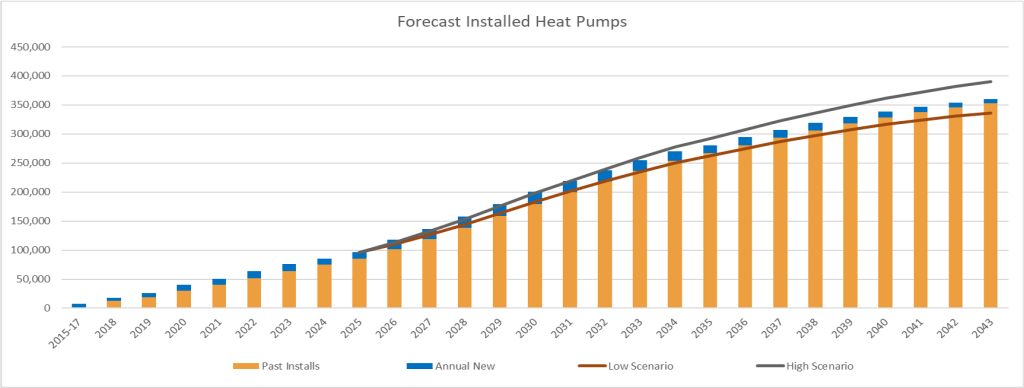
Due to these headwinds, heat pump adoption is anticipated to grow at a slower rate than previously projected, according to the report. But experts, including those at energy utility Efficiency Vermont, say they’ll continue to push technology to reduce the state’s reliance on fossil fuels.
“This is a long process, taking years and years of education and outreach to really see the behavior change,” said Matthew Smith, a spokesperson for Efficiency Vermont.
A trio of issues
Cold-climate heat pumps are among the least expensive sources of heat for homes, cheaper on average than propane or heating oil. And because they’re powered by electricity, they’re a way to reduce household carbon emissions.
But even in the current moment, heat pumps are not reaching their full potential to save money and energy. According to the report, heat pumps are not only used less but are saving less than state officials expected.
Part of the problem is Vermont’s cold climate. During bouts of cold weather, some customers turn off their heat pumps, the report says, to rely on other fuels. This is due to the systems being pushed to their limit, sometimes leading to unexpected increases in electric bills.
“In single-digit temperatures, heat pumps still work, but efficiency and output drop, operating costs rise, and poorly weatherized homes often require expensive backup heat to stay comfortable,” said Michael Touchette, general manager of Vermont Energy, a heat pump dealer.
But the report argues that the technology alone isn’t to blame, noting that consumer education and behavior are part of the issue. Smith says homeowners need to become more familiar with heat pumps and their limitations before installing them, including that having a weatherized home would help them operate more effectively.
Vermont’s housing stock, however, was “built before there were anything resembling weatherization standards,” Smith said.
Efficiency Vermont, which offers homeowners a wide variety of efficiency-related rebates, also works to inform Vermonters about the importance of weatherization. Smith stressed the importance of “complementary actions” when installing heat pumps, including improved insulation and air-sealing.
To weatherize 120,000 homes by 2030 – a goal set by the state in the Comprehensive Energy Plan in 2022 – Vermont would need to grow its weatherization contracting workforce from roughly 800, as estimated in 2022, to around 6,000.
“Available workforce, long-term funding and organizational capacity remain insufficient to meet that aspirational target,” the report says.
Even when installers recommend that homes be weatherized, “some homeowners choose not to prioritize it,” Touchette said, later adding, “Without adequate weatherization, much of that investment is simply lost.”
Builders also aren’t always following state rules designed to make homes more energy efficient, state Rep. Scott Campbell, D-St. Johnsbury, said.
Campbell has a background in construction and is a member of the state’s Building Energy Code Working Group, which was formed in 2024 to recommend strategies for increasing compliance with residential building energy standards.
Consumers and builders alike “aren’t aware that we have these mandatory energy codes,” he said. When competing against other builders, code requirements can get ignored. If the rules go unenforced, systems can be installed improperly, which Campbell said can lead to insulation and moisture concerns.
“We’ve sort of let builders off the hook,” Campbell said. “Nobody’s checking.”
The working group that Campbell is a part of recommended reforming the enforcement of energy codes by creating effective, yet achievable standards.
Meantime, Smith said Efficiency Vermont will continue finding ways to promote heat pumps and educate users on strategies to optimize their efficiency.
The organization, he said, is “troubleshooting at every level.”