

CVU Turf Field: The Proposal is Presented
Eli Lesser-Smith says his project is safe and will help athletes and the community. Many supporters; concerns in Hinesburg. Video and audio for those who couldn't make it.
(Editor’s note: click the audio player above if you wish to hear the entire presentation and Q&A period. And click here for video, audio and text of panel discussion about health concerns held Friday.)
By Geoffrey Gevalt
The Record Staff
Several hundred people – students, parents, citizens of Hinesburg and of other communities – crowded into the CVU library Wednesday night to hear the formal proposal for a privately financed $5.5 million artificial turf field at CVU.
After CVSD Superintendent Adam Bunting started the meeting by asking for civility and saying there would be a process to this proposal, Eli Lesser-Goldsmith, the proponent and organizer of the project, had this to say:
“Why are we doing this and why is this project needed? The forefront of our effort is to build community and inspire joy. … This is something the world needs more than ever right now. This project will inspire people to come together as a community, with their friends and neighbors for amazing events, for people of all ages for generations to come.
“Let’s start with some key facts. This exact field is already in use all over Vermont and all over America. We are not reinventing the wheel. … Because we care so much about the environment, this project improves the current environmental conditions of the space by improving stormwater management.
“The new site will be accessible to all, including a brand new ADA [Americans with Disabilities Act] parking lot, ADA access paths, and ADA event-viewing. And this project is 100 percent privately funded; there will be no cost or burden to taxpayers.”
In an interview with The Record on Sunday, Lesser-Goldsmith emphasized several other points: By the definition of Vermont’s new law banning PFAS (“forever chemicals”) the field will comply with the law and the stormwater drainage system will keep anything from leaching into the town’s water wells.
After a relatively short presentation of slides (link here if you wish to view), Lesser-Goldsmith and his team outlined their view that the artificial field will be less costly to maintain and safer for the athletes; will minimize the times student athletes have to be bused to other locations for practices or games because the fields are too wet or soggy for use; and will be a huge boon to the community.
“Since announcing this project, we have received overwhelming support from administrators, community members, students, athletes, alumni, and more. We have had tons of meetings with stakeholders across a wide range in the community resulting in broad support and excitement.
“We are building community pride, school pride, student pride, and excitement for years to come. We care about our student athletes and believe this is the best technology to support their growth, development, and opportunities. And lastly, we are building something that will benefit thousands of kids, students, community members, and more, for generations to come.”
With that, Lesser-Goldsmith opened the presentation up for questions and, as it turned out, statements.
Questions abound
While there was occasional applause for what people said or asked – and it was clear there was more support than opposition in the room – the session was, as Bunting had requested, a civil one.
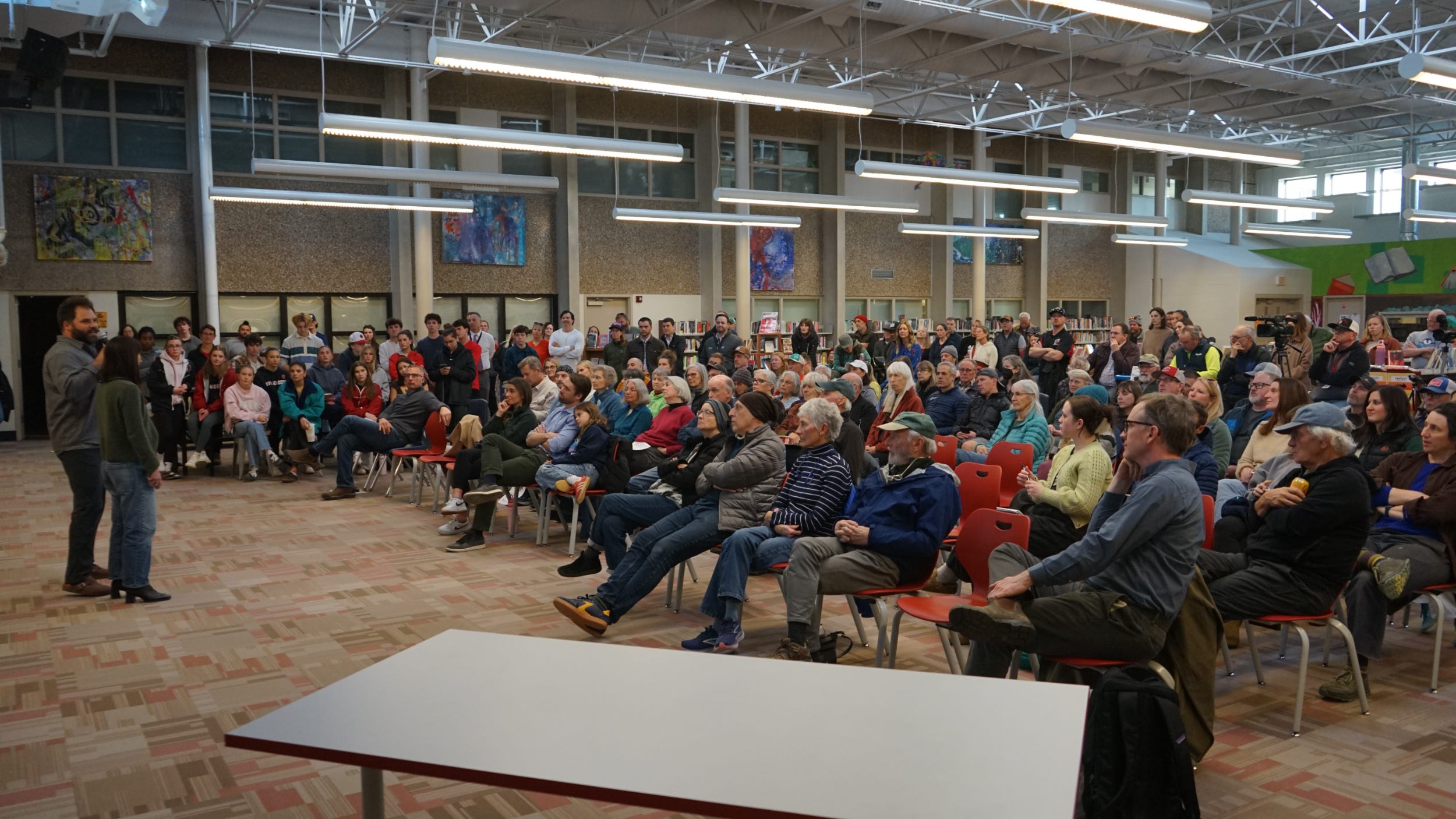
Student athletes talked about how difficult it was to lose home-field advantage in the boys’ and girls’ soccer and girls’ field hockey playoffs last fall and how taxing it is to have to get up at “five in the morning” to go practice at Shelburne Field House or other locations for practice.
Parents said their kids deserved to have fields equal to the quality of many of the other high schools. A coach said that participating in athletics was an important part of students’ mental health and the fields’ often poor condition diminished their experience.
Several asked what happens when the field needs replacing? Andrew Dyjak, a spokesman for FieldTurf, the company aligned with the proposal, said the old field would be recycled (something refuted in Friday night’s panel discussion about the project) and that it would cost approximately $600,000 to replace in about 15 years. In response to questions about who would bear that cost, Lesser-Goldsmith said the group would look into that part of the project.
In the Sunday interview, Lesser-Goldsmith said his group was putting together a projected cost analysis that would show that the reduced cost of maintaining the fields, plus the potential income from concessions, tickets and rental, would raise sufficient money over the years to eliminate the need for public funds for replacement.
Dyjak also said “there is no runoff” from the field that water permeates down through the field into the infill and rock drainage. He also said the materials were PFAS-free (“forever chemicals”) and would meet the requirements of Vermont’s new restrictions on artificial fields. He added that the company has tested for PFAS and tests have come back with no detectable levels.
“We can go back and forth on this,” Dyjak said, “but I’m just going to say it definitively, EPA and the state of Vermont – and the new act that they passed – we are completely in compliance.”
Several audience members refuted Dyjak’s claims, noting that only a small number of PFAS are actually tested and the “detection levels” are such that while they satisfy the “PFAS-free” benchmark, they do contain PFAS substances. Jennifer Decker of Hinesburg, a vocal opponent of artificial turf, asked if FieldTurf would supply a sample of its product for independent testing. Absolutely not, Dyjak said.
In the interview, Lesser-Goldsmith said the important point was that the field “meets the letter of the law,” and if opponents feel that there should be more extensive testing required, they should work with the Legislature to change the law.
One parent added, “I hear the concerns of a lot of the residents and I understand there’s concerns, and you’re asking good questions. But I can tell you right now, people are wearing more PFAS in this room than are in this field.”
A local engineer working with the group, Kevin Worden, outlined the extensive drainage plan – admitting that his company did the drainage for the existing fields and it wasn’t adequate. This plan, he said, would capture and contain any runoff and prevent it from getting into the groundwater.
Yet several in the audience said that one of the biggest worries in Hinesburg is that the field runoff will contain PFAS and micro- nano-plastics that will get into the air and be absorbed by athletes and nearby residents and will eventually find its way into the town’s wells.
Several people suggested that grass fields would be a better alternative. The response was that while a grass field could be constructed it would cost a great deal to maintain, would have runoff of fertilizers and silt and would still be less available for use than an artificial field.
In the interview, Lesser-Goldsmith said “we went through an exhaustive process to figure out what the best solution would be. We considered many different paths and options, and we arrived at a[n artificial] turf athletic field, being the best solution for CVU and the community.”
“So, grass fields are not a possible avenue?” he was asked.
“This is the project that we are offering the district. This, we feel, is the best option for the district, for the school, for the community, for the kids.”
There was discussion of the current costs of the fields – regular maintenance as well as the cost of renting other locations and transportation costs. The group said that the current costs – which were not identified – would be reduced by 90 percent with the artificial field.
Near the end, one woman, speaking about the testing done by FieldTurf and others around the artificial turf product, said, “I do hear concerns about micro-plastics. … What would elevate your company is finding a way to make tests across all of the plastics. Yes, you can meet Vermont criteria, but that’s not elevating. Elevating is testing everything in every way possible.”
In closing, Bunting told the audience that “tonight I think you got to see what a good community dialogue looks like. … I would hate for people to walk out of this room and be polarized.
“On the 14th, Tuesday next week, is the beginning of a board discussion. … I want to be clear that the board is not taking any action in that meeting. The way that our process works, we discuss, we discuss, and when we get to a place where we feel like we’re ready to take action – and the action in this situation will be the board determining whether we enter into an agreement to accept a gift down the road.”
Later, Bunting told The Record that the first step will be to determine all the questions the need to be answered, starting with “is it safe?” and “will it polarize the community?”
Is artificial turf unfair to 🐮🐄 cows, 🐐🐐 goats, and 🐑🐏 sheep ❓❓Bah ‼️👋🤣🌹👌🤠♥️✌️😼