

Word of the Week: Abjure
Nowadays, we do it casually, but centuries ago it could mean life or death.
By Cathy Ryan
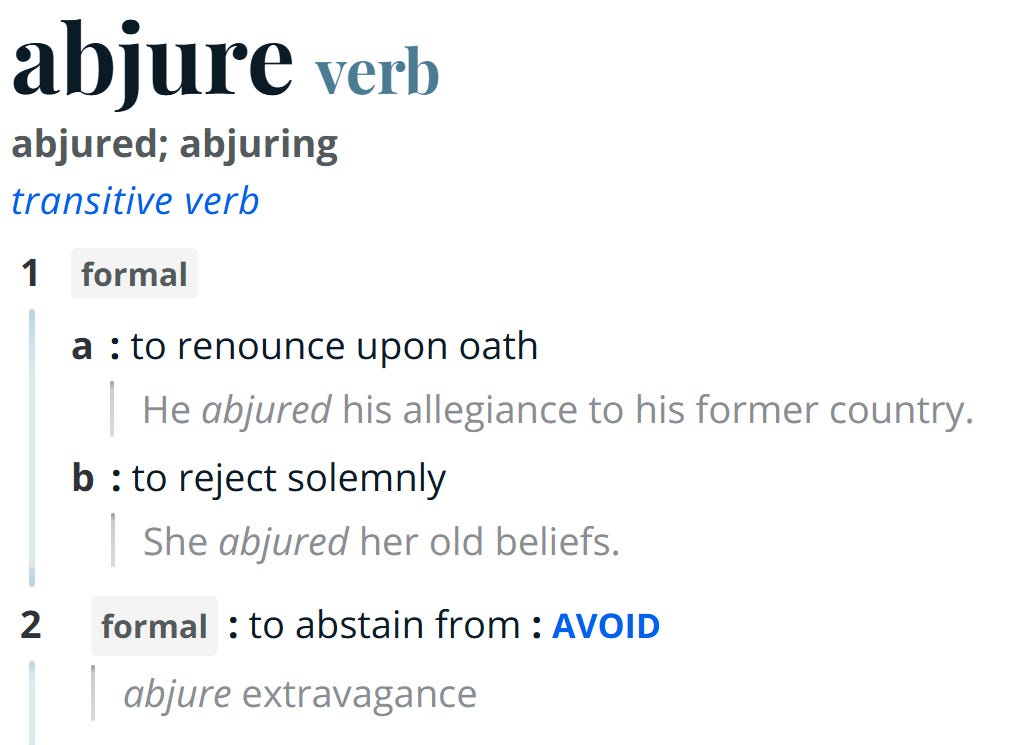
This week’s Word of the Week is abjure. It means to renounce or reject something – to give it up. Merriam-Webster’s webpage on abjure explains how abjure and jury come from the same Latin root:
Just as a jury swears to produce an unbiased verdict, and a witness swears to tell the truth on pain of perjury, those who abjure their former ways “swear them away.” Abjure (as well as jury and perjury) comes from Latin jurare, which means “to swear” (and which in turn is based on the root jus, meaning “law”), plus the prefix ab-, meaning “away.” These days, we can casually abjure (that is, abstain from) various vices, but in the 15th and 16th centuries to abjure was a matter of renouncing something under oath – and sometimes a matter of life and death. For example, during the Spanish Inquisition, individuals were given the choice between abjuring unacceptable beliefs and being burned at the stake.
I’ve read this word in two different books – The Secret Commonwealth by Philip Pullman, which is the second volume of his trilogy The Book of Dust; and Not So Much, Said the Cat, a collection of short stories by Michael Swanwick.
The word’s usage in The Secret Commonwealth emphasizes the seriousness of abjuring something (or not):
I have a distant cousin in Yerevan, Your Blessedness, whose family were put to the sword by a band of men who wanted them to abjure the Holy Church and the doctrine of the Incarnation in particular.
I enjoyed reading Pullman’s series, which starts with the book The Golden Compass. A young girl goes on a daring adventure to the Arctic with her dæmon by her side. This is yet another series of books that was written for youth, but that many adults love. You can always read The Golden Compass and then decide for yourself whether to continue with the rest of the series.
Unfortunately, I don’t know whether to recommend the short story collection Not So Much, Said the Cat, because I don’t remember a thing about it! I bought the ebook in 2016 and finished reading the book (reading progress is saved on the Kindle) but I don’t remember it at all. You’d think the opening line of the story Tawny Petticoats would be unique enough to dredge up some recollection, but unfortunately not:
The independent port city and (some said) pirate haven of New Orleans was home to many a strange sight. It was a place where sea serpents hauled ships past fields worked by zombie laborers to docks where cargo was loaded onto wooden wagons to be pulled through streets of crushed oyster shells by teams of pygmy mastodons as small as Percheron horses.
I guess the up-side of my poor memory is that I can now read and enjoy this story a second time. The word abjure appears in a disagreement between two fellows:
“Working with an amateur is one thing – but this woman is a professional. She will sleep with both of us, turn us against each other, and in the end abscond with the swag, leaving us with nothing but embarrassment and regret for all our efforts.”
“That is a sexist and, if I may dare say so, ungallant slander upon the fair sex, and I am astonished to hear it coming from your mouth.”
Darger shook his head sadly. “It is not all women but all female confidence tricksters I abjure. I speak from sad – and repeated – experience.”
Bonus Word: Adjure
Note that abjure is very similar in spelling to adjure, but they are quite different. Adjure means to beg, command, or beseech with insistence. They both have the same Latin root, but, as noted above, the prefix “ab” means “away” whereas “ad” means “toward.” So abjure means to swear off something, whereas adjure means you want someone to swear to something – to agree to something.
You can read previous Word of the Week articles here.