

Word of the Week: ell
from Frances E. Willard's 1895 book, A Wheel within a Wheel: How I Learned to Ride the Bicycle
By Cathy Ryan
The Record staff

This week’s Word of the Week is “ell.” I read this word in Frances E. Willard’s 1895 book, A Wheel within a Wheel: How I Learned to Ride the Bicycle. An ell is an old English unit of measure, of about 45 inches (see more in the Merriam Webster definition). The sentence in the book is, “We all know the old saying, Fire is a good servant, but a bad master. This is equally true of the bicycle: if you give it an inch—nay, a hair—it will take an ell—nay, an evolution—and you a contusion, or, like enough, a perforated kneecap.”
This book is in the public domain, and you can read it online at Project Gutenberg.
Willard’s book is about more than just how she learned to ride a bicycle. It is about motivation and trepidation — the excitement of learning something new and the thrill of success, and the fears of ridicule, failure, and personal injury.
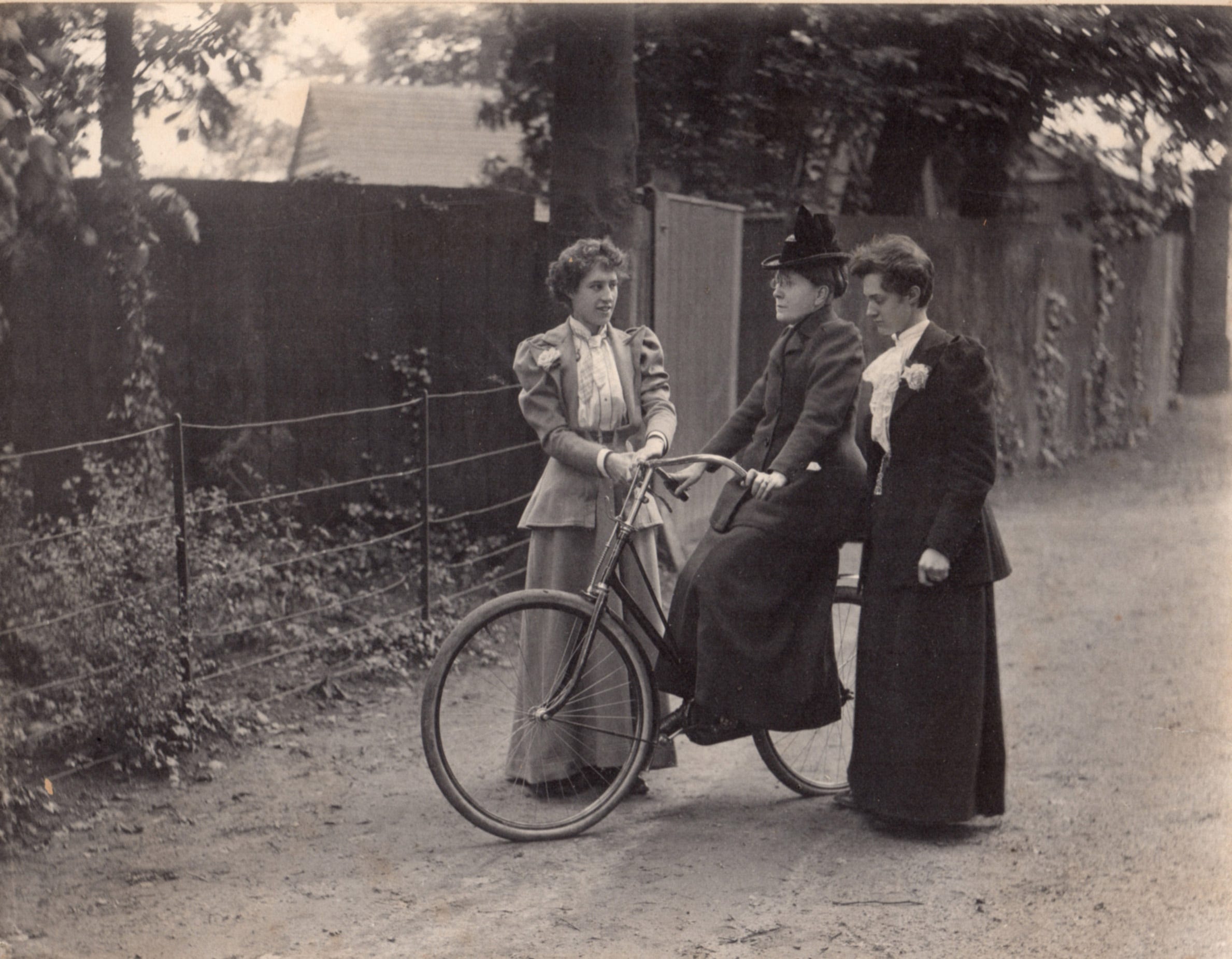
Frances Elizabeth Caroline Willard was born in 1839 in Churchville, New York, and spent most of her childhood in Janesville, Wisconsin. She was an educator, a temperance reformer, and women’s suffragist. Her work was instrumental in the passing of the Eighteenth and Nineteenth Amendments to the U.S. Constitution (Prohibition and women’s right to vote), raising the age of consent in many states, and instituting an eight-hour workday. Willard’s many professions included: a public school teacher, President of Evanston College for Ladies, Dean of Women at Northwestern University, a newspaper editor, a public speaker, an author, and President of the Woman’s Christian Temperance Union (WCTU). The WCTU had a three-prong mission of abolition, suffrage, and temperance.
Although Willard was briefly engaged, her primary loyalties and relationships were with women, including her longtime companion Anna Adams Gordon. Her fight for temperance focused on “home protection” — protection from the devastation caused by intoxicated men, both in and outside of the home. She argued that if women could vote, they could vote in prohibition.
Willard was a feminist, but also became a socialist and fought for a wide variety of social reform: federal aid for education and school lunches, unions and worker protections including an eight-hour workday, sanitation, public transportation, anti-rape laws, protections against child abuse, prison reform, and world peace.
Willard’s interest in the independence, health, and well-being of women naturally led her to embrace the bicycle. Bicycles allowed women to travel farther distances, without a chaperone, and gave many women their first sweet taste of freedom. Bike-riding women pushed for clothing reform, so that they could wear clothes more suitable for bike riding. Susan B. Anthony and Elizabeth Cady Stanton are credited with declaring that “woman is riding to suffrage on the bicycle,” a line that was printed frequently in newspapers around the turn of the century.
To men, the bicycle in the beginning was merely a new toy, another machine added to the long list of devices they knew in their work and play. To women, it was a steed upon which they rode into a new world.
—Munsey’s Magazine, 1896
Let me tell you what I think of bicycling. I think it has done more to emancipate women than anything else in the world. I stand and rejoice every time I see a woman ride by on a wheel.
—Susan B. Anthony, 1896
Of course, learning a new athletic pursuit in one’s fifties is not always a simple task, as this book attests to (especially when wearing the standard women’s clothing of the day). But (spoiler alert), she does successfully learn to ride, and ends the book with the encouragement, “Moral: Go thou and do likewise!”