

Word of the Week: Intestate
and some tips to make that situation less difficult
By Cathy Ryan
Hinesburg Record staff writer
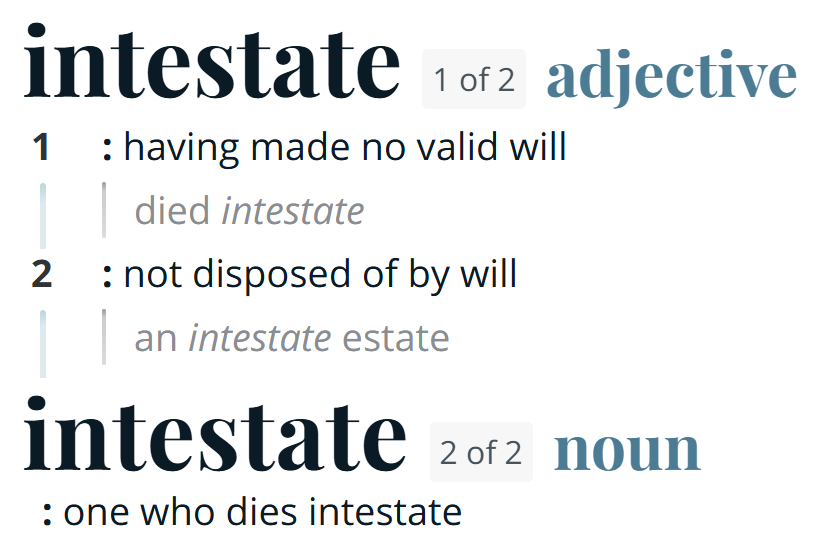
This week’s Word of the Week is intestate. I was reminded of this word recently because I’m helping a friend whose father passed away. Except, I couldn’t remember the word, so I Googled “what’s the word for when someone passes away without a will?” It is pronounced with the emphasis on the second syllable (similar to intestine), not the first syllable (like interstate). It’s important to know the word so that you can ask for help if you find yourself in this situation: “My father died intestate - what do I do?”
Note: I am not an expert in any of this; you should consult a lawyer and/or state and county officials before making any decisions or taking action.
When someone dies without a will, state laws determine who inherits that person’s estate (property, bank accounts, etc.). In Vermont, the order of inheritance in the absence of a will is (source: VT Statutes Online):
Spouse but no children/parents: The spouse inherits everything.
Spouse and children (all from the marriage): The spouse inherits everything.
Spouse and children (from a prior relationship): The spouse receives half of the estate, and the children split the other half.
Children but no spouse: The children inherit everything.
No spouse or children: The assets go to the decedent’s parents, then siblings, then more distant relatives if no immediate family exists. Unmarried partners and friends do not inherit under state law.
Note that ex-husbands and ex-wives do not inherit anything, unless specified in a will. However, see my note below about Social Security.
You may look at these rules and decide that you are good with this default, and think you don’t have to make a will or do anything else. But please reconsider. In addition to these default inheritance rules, you can specify items or money that should go to friends, or more distant family members who otherwise wouldn’t inherit anything. If you do make a will, you should deposit it with the courts (see this page, under “Depositing a Will with the Court”) and also tell your family.
My understanding is that the court will not seek out survivors – the survivors need to know to ask the County Probate Court if a will is on file. So, telling your family that there is a will on file will make things easier for them.
If a family member passes away and you don’t know what to do, with regard to their estate or assets, call the County Probate Court and ask for help. It’s their job to help with this kind of situation. You should contact the county in which the person resided at the time of death (not necessarily the county in which they died). Here is contact information for each county court. Look for the Probate Court for the correct county.
IRA Beneficiaries and Payable on Death Accounts
There are some other ways that you can make things easier for family members after you pass away (and these are things that survivors can look into).
“Payable on Death” (POD) bank account designations: You can specify one or more people to inherit your checking account, savings account, money market account, or certificates of deposit (CDs) upon your death. Ask your financial institution for information. This designation will take precedence over what you put in your will. The designee only needs to present a copy of the death certificate. (And they need to know that this has been set up, so tell them!) This can be very helpful, when other assets are tied up with the court process, so that funeral expenses, travel expenses, etc., can be paid for. More info here.
Beneficiaries for Retirement Accounts (IRA): If you have a retirement account such as a 401k, you’ve probably been asked to specify beneficiaries. Check these regularly – you might not have thought about this since the account was set up, and your wishes may have changed. These people will inherit the account (or their percentage of the account) upon presentation of the death certificate. This designation takes precedence over any will.
If a spouse inherits an IRA, they can either roll it over into their IRA, or keep it as an Inherited IRA Account. A non-spouse cannot roll it over into their IRA. It stays as an Inherited IRA Account, and in most cases all the money has to be withdrawn within 10 years. Money can be withdrawn from an Inherited IRA at any time – very helpful for the recipient when dealing with funeral and travel expenses, etc. Money withdrawn counts as income, and you must declare it and pay income tax on it. The financial institution may withhold taxes for you. More info about specifying beneficiaries here. More info for someone inheriting a retirement account here.
For Spouses and Exes – Social Security Benefits
This is a case where I’m not going to say much, because I don’t want to get it wrong – I’ll just tell surviving spouses (married for at least nine months) and surviving divorced spouses (married at least 10 years) to contact the Social Security Administration (SSA) to ask about benefits. If your spouse (or ex-spouse) was receiving more benefits than you are, you might be entitled to receive more. More info from SSA, including contact info here and some info from AARP here.
The Take-Away: Do Things, Then Tell Your Family
I highly suggest you make a will, specify beneficiaries for retirement accounts, specify “Payable on Death” recipients on bank accounts, and then tell your family. And not just verbally – people forget things. Write down information such as bank and retirement account financial institutions, who the beneficiaries are that you’ve specified, whether you’ve written a will (and if so, whether you’ve filed it with the county), etc. Put it somewhere safe and give copies to family members. And in that documentation, remind “Payable on Death” designees that they can access that money right away.
Dealing with your death will be hard enough for them – do what you can to make it easier.
You can read past Words of the Week here.
Great info!