
Word of the Week: Overweening
You've probably never heard of the book that A. A. Milne said was his best.
By Cathy Ryan
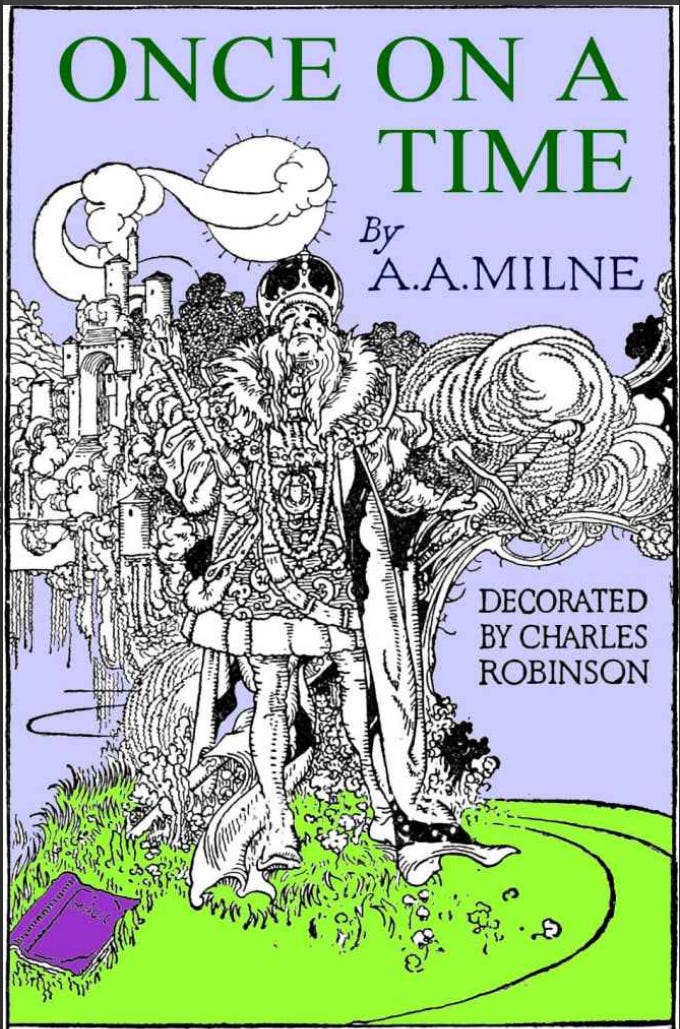
This week’s Word of the Week is overweening. It is an adjective meaning excessively arrogant, or overconfident. I read this word in a book by A. A. Milne. No, not Winnie-the-Pooh. I read it in Once on a Time, which was published in 1917, before he wrote the Winnie-the-Pooh books. Milne was a prolific and diverse writer, writing plays and screenplays, novels, poems, and nonfiction, in addition to his famous children’s books.
Overweening appears in the following description of a character:
The Countess Belvane! What can I say which will bring home to you that wonderful, terrible, fascinating woman? Mastered as she was by overweening ambition, utterly unscrupulous in her methods of achieving her purpose, none the less her adorable humanity betrayed itself in a passion for diary-keeping and a devotion to the simpler forms of lyrical verse.
As the title suggests, Once on a Time is a fairytale. But Milne said he wrote it for adults – specifically as amusement for his wife and himself, “at a time when life was not very amusing.” He wrote it in 1915 during World War I. In the preface to the 1922 edition, Milne tried to explain further:
For whom, then, is the book intended? That is the trouble. Unless I can say, “For those, young or old, who like the things which I like,” I find it difficult to answer. Is it a children's book? Well, what do we mean by that? Is The Wind in the Willows a children's book? Is Alice in Wonderland? Is Treasure Island? These are masterpieces which we read with pleasure as children, but with how much more pleasure when we are grown-up.
I read a description of Once on a Time as “a fairytale sendup.” So then I had to go look up sendup to make sure I understood. A sendup is “a humorous imitation or parody of a specific person, style, genre, or work. It exaggerates familiar traits or mannerisms for comic effect, often making the subject appear foolish.” So it’s basically a fairytale that makes fun of fairytales, such as having pompous, self-absorbed kings who go to war for an absurd reason. It could also be described as a satirical fairytale.
In the preface to the 1922 edition, Milne said that whenever someone praised his books, he would say, “But you have not read the best one!” and most of the time, this was true – they hadn’t read Once on a Time.
There were so many amazing authors living in England at the same time: Milne had H. G. Wells as a math teacher; and was on a cricket team with fellow authors J. M. Barrie (Peter Pan), Arthur Conan Doyle (Sherlock Homes), and P. G. Wodehouse (Jeeves and Wooster). You can read about this (apparently terrible) team in this BBC article.
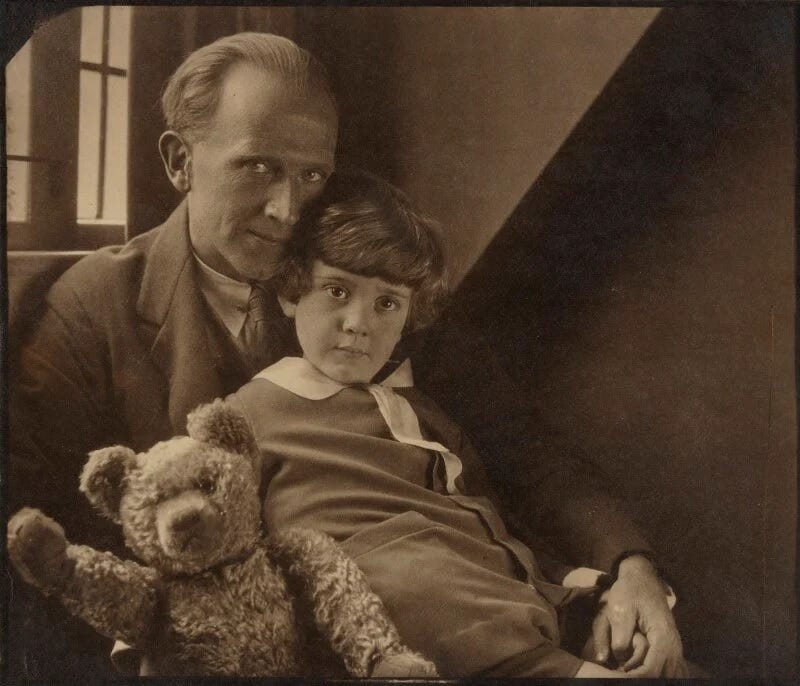
The fame of the Winnie-the-Pooh books was a source of frustration for Milne; he preferred to be able to write whatever he wanted, but people were constantly asking him to write more Pooh books. He also didn’t anticipate the issues his son Christopher Robin would face, sharing the same name as the boy in the books. His son was teased in school and had to deal with his name being famous for the rest of his life. Christopher Robin became estranged from his father, because he resented the fame his father unwittingly forced upon him. What may have been different if Milne had simply not used his son’s real name in the stories?
Once on a Time is in the public domain and you can read it online at Project Gutenberg. I enjoyed it, but as Milne explained, sometimes you just don’t know if someone will like a certain book:
But, as you see, I am still finding it difficult to explain just what sort of book it is. Perhaps no explanation is necessary. Read in it what you like; read it to whomever you like; be of what age you like; it can only fall into one of two classes. Either you will enjoy it, or you won’t. It is that sort of book.