
Word(s) of the Week: Jings, Japes, and Boffo
fun words from a great book series for kids and adults
By Cathy Ryan
This week’s Word of the Week is a 3-for-1. All three words are from a book I’m currently reading, Wintersmith, by Terry Pratchett. I know, I mentioned another of Pratchett’s books, The Hogfather, in a previous Word of the Week, but I just couldn’t resist, because this book series is amazing, and I come across a fun word every few minutes.
Wintersmith is the third book in the five-book Tiffany Aching series, set in Pratchett’s Discworld. He was a prolific writer, with over 41 books set in Discworld. Some of the books (like The Hogfather) can be read out of order, but many are in groups, or subseries, where it’s best to read them in order, and I highly recommend that for this subseries. So, you should start with the first book in the series, The Wee Free Men.
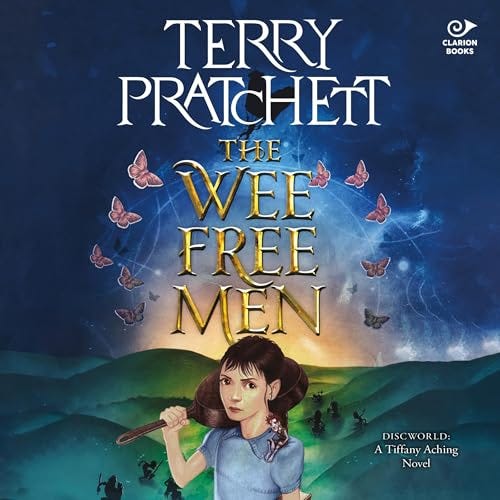
The series is considered “young adult” – appropriate for middle school kids and older, but I didn’t know that when I started reading the books, and I’m thoroughly enjoying them. I think it would be a great series for parents and kids to read at the same time.
This series focuses on Tiffany, who is nine years old in the first book; she turns 13 in the third book. She’s a young witch but doesn’t really know it yet. But other witches in the area are noticing, and start training her. She’s befriended by small, blue-tattooed, six-inch-tall fairy folk called the Nac Mac Feegle. They are as far from “fairy-like” as you can imagine – they curse, steal, drink, lie, fight, and carry on in a hilarious way.
So let’s get to the words.
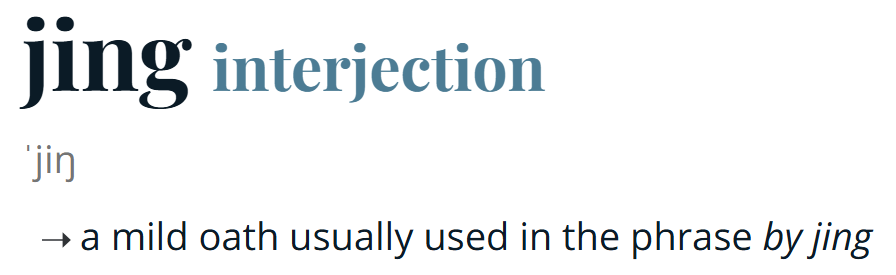
Merriam-Webster lists “jing” but in the book it’s “jings” – “Jings! I see you there, ye wee schemies!” It’s a Scottish exclamation of surprise or amazement, similar to “Oh my goodness!” This was spoken by a Nac Mac Feegle. Their dialect in the books is a tiny bit difficult to read and understand, but once you’re a couple books in, you’ll be an expert.
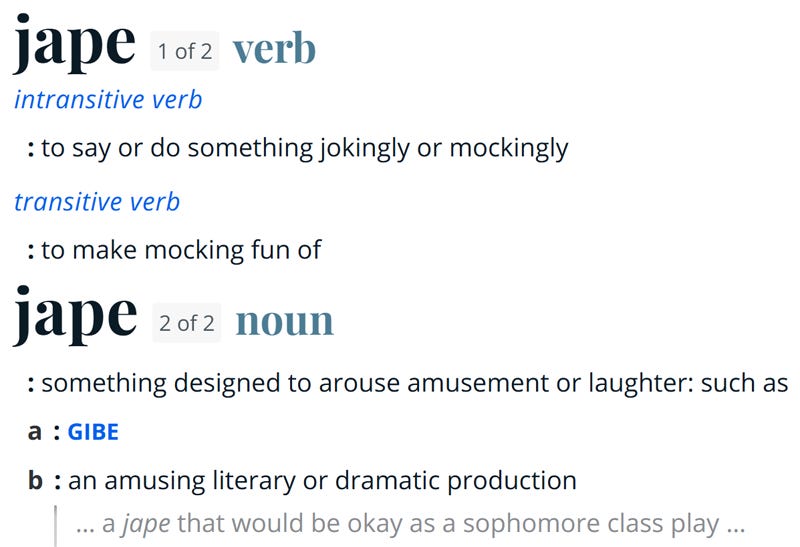
“Jape” can be a verb or a noun – a practical joke, or to perform a practical joke – to be silly. In Wintersmith, one witch got some items from a certain company:
“The Boffo Novelty & Joke Company!
Guffaws, Jokes, Chuckles, Japes Galore!
If it’s a laugh, it’s a BOFFO!”
That advertisement also uses our third word:
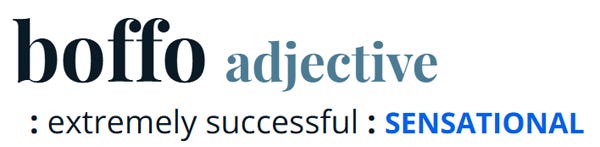
Merriam-Webster says that boffo came about in the 1930’s and 1940’s and may have started as a shortening of “box office” – a box office hit is boffo. It can also be used as a noun – something can be “a boffo.” The definition page links to an article called “7 Great Ways to say Great” and boffo is at the top of the list.
In Wintersmith, it refers to the calculated use of props, costumes, and theatrical tricks to enhance a witch’s reputation and power. Witches serve a community, providing minor medical assistance, helping the elderly, settling disputes, etc. But in order for a community to trust a witch, they have to believe she has power. They expect witches to be a certain way, so one witch in particular uses a bit of boffo to be a bit more “witchy.”
“That was the magic of the pointy hat. It was what Miss Treason called ‘Boffo.’”
But serious situations sometimes call for seriousness – no boffo:
“This was witching cut to the bone. No toys, no wands, no boffo, no headology, no tricks. All that mattered was how good you were.”
I truly think this series is boffo, and I hope you check it out, either for a middle-schooler in your life, or for yourself. Tiffany is an amazing, strong, smart, courageous character. That frying pan she’s wielding in the book cover above? Spoiler alert – she knows how to use it, and I don’t mean for cooking.
From the beginning of the first book in the series, The Wee Free Men:
“Another world is colliding with this one,” said the toad. “All the monsters are coming back.”
“Why?” said Tiffany.
“There’s no one to stop them.”
There was silence for a moment.
Then Tiffany said, “There’s me.”