
Word of the Week – Dicta
Irregular plurals, a bit of Latin, and how this relates to "I know it when I see it" and "Corporate Personhood."
By Cathy Ryan
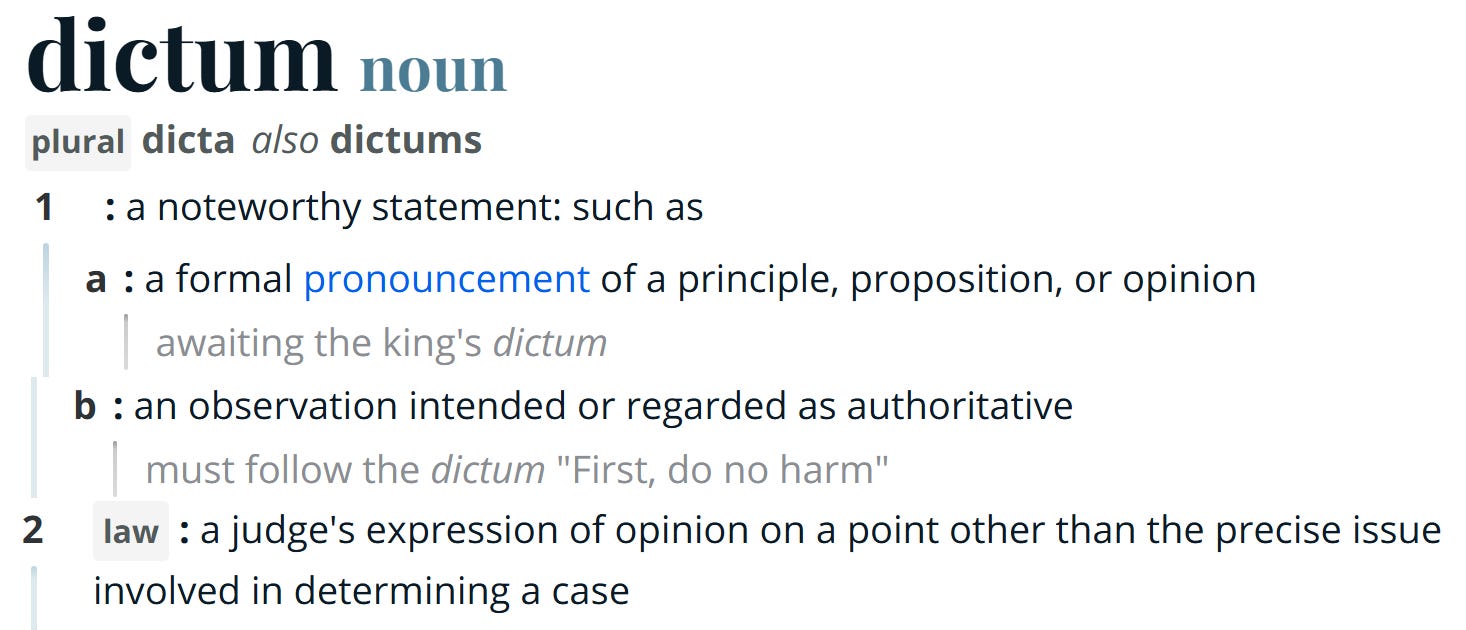
I was playing a word game recently, and in a bout of desperation, entered dicta. To my surprise, it was accepted! But then, of course, I had to go look it up. Dicta is the plural of dictum. A dictum is a short statement that expresses a general truth, principle, or authoritative rule, such as “You are what you eat,” “First, do no harm,” and “Honesty is the best policy.”
Here’s another example, from Stephen King’s short story “Lunch at the Gotham Café” in the collection Everything’s Eventual:
My father’s dictum: If you need to be there, show up five minutes early. If they need you to be there, show up five minutes late.
As I’ve mentioned before, I like Stephen King, but I can’t really recommend his writing in general, because… it’s Stephen King. It’s gory horror, which isn’t for everyone. And this short story is no exception.
The plural of dictum is dicta, which makes it an irregular plural noun. It’s because this word derives from Latin. It actually has a lot of company in English, such as atrium, datum, bacterium, forum, momentum, millennium, curriculum, and memorandum. With all of these words, to make the plural, remove “um” and add “a”: data, bacteria, etc. Did you know the plural of forum is fora? You’re welcome, Scrabble players – fora is a playable word! This also means that the version ending with “a” is plural. So technically, you should say, “The data indicate...” not “The data indicates…”
There are some cases where words have been more fully “Englishized” (that IS a word, according to Merriam-Webster, although my spell checker is throwing fits) and a more typical plural is also acceptable, such as the plural of atrium being either atria or atriums.
Dictums also hold a huge place in history in the form of law decrees. As the above definition graphic describes, dictum also means a statement made by a judge, that is not part of the binding law decision, but is often referred to in the future by lawyers and judges. Obiter dictum (plural orbiter dicta) is a Latin for “said in passing.”
One famous obiter dictum occurred in Jacobellis v. Ohio, which was a landmark 1964 Supreme Court case that overturned the obscenity conviction of a Cleveland Heights, Ohio, theater manager who showed the French film Les Amants (The Lovers). Justice Potter Stewart, in his concurrence, stated that the Constitution protected all obscenity except “hard-core pornography.” He wrote, “I shall not today attempt further to define the kinds of material I understand to be embraced within that shorthand description; and perhaps I could never succeed in intelligibly doing so. But I know it when I see it, and the motion picture involved in this case is not that.”
Another very significant dictum comes from the 1886 Supreme Court case Santa Clara County v. Southern Pacific Railroad Co. In this case, even before oral arguments began, Chief Justice Morrison R. Waite made a casual statement to the court reporter. He stated that the court did not wish to hear argument on whether the Fourteenth Amendment applied to corporations because the members were all of the view that it did. Court reporter J.C. Bancroft Davis included this statement in the decision’s headnote, which is part of the official decision. This recognized corporate personhood, and we’ve had to deal with the ramifications of this ever since.
On a funner note (Merriam-Webster seems to say this is a word, and the Scrabble player’s dictionary agrees, so I’m using it henceforth), perhaps you’ll be able to use dicta, fora, or funner in some word games in the future, and score a ton of points.
You can read previous Word of the Week articles here.