

Word of the Week: Nonce
An interesting word used by Stephen King and George MacDonald; and a very different British English definition...
By Cathy Ryan
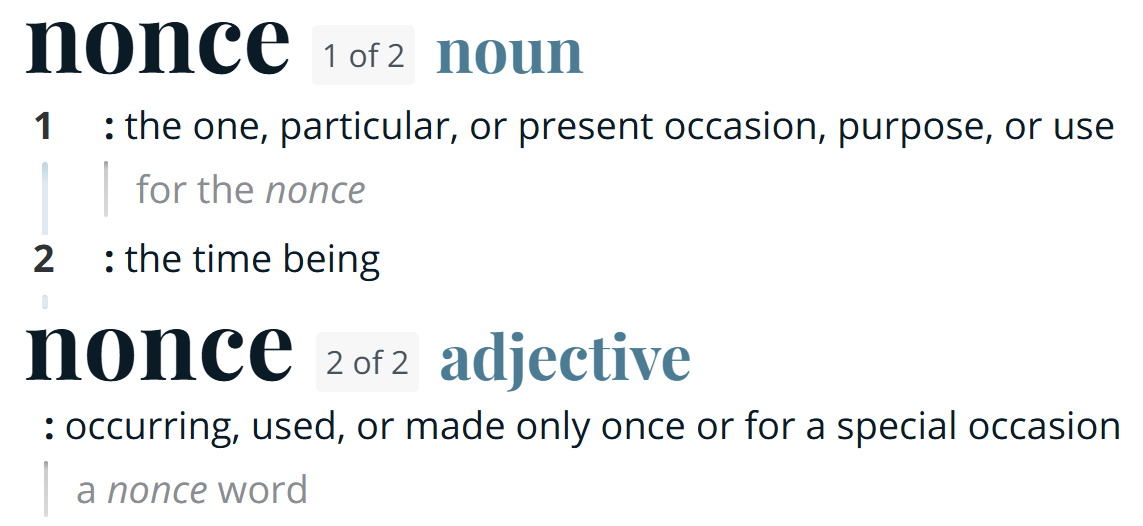
I’m an avid Wordle player, so I’m always happy to learn a new five-letter word. This week’s Word of the Week is nonce. I read it in Stephen King’s Black House:
“And here we are, in the speaking circle,” Parkus says. His smiles have been put away for the nonce.
In its noun form, it means the present occasion. “For the nonce” is similar to “for the time being.”
In its adjective form, it describes something made or invented for just one certain occasion. For example, linguistic researchers will often make up a word – which is then called a “nonce word” – for testing children’s understanding of a language. They might hand an item to a child and say, “This is a wug. if you had three of them, you would have three…” and if the child answers “wugs,” they know the child applied a language rule to a new situation. They know the child didn’t simply memorize “wugs” from hearing it before, because they’ve never heard it before – it’s a nonce word.
Unfortunately, I can’t really recommend King’s Black House unless you are a die-hard Stephen King fan, and have read the first book in the series, The Talisman – in which case, go for it! The third and final book in the series is coming out this fall. There is quite a bit of graphic violence in Black House.
So, I searched my Kindle to see if nonce appears in any other books I have – one that I can more enthusiastically recommend. It does! It’s in The Shadows, a short story by George MacDonald (1824-1905).
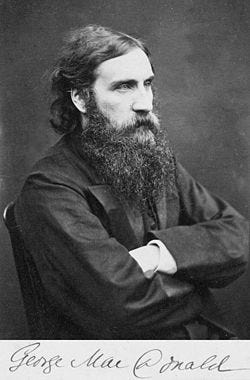
George MacDonald’s writing is all in the public domain, and you can read his stories online or download ebook files at standardebooks.org. The story Shadows is in a collection of short fiction found here. “Nonce” appears in this paragraph:
When they came in sight of the mountain-lake, the king saw that it was crowded over its whole surface with a changeful intermingling of Shadows. They were all talking and listening alternately, in pairs, trios, and groups of every size. Here and there large companies were absorbed in attention to one elevated above the rest, not in a pulpit, or on a platform, but on the stilts of his own legs, elongated for the nonce. The aurora, right overhead, lighted up the lake and the sides of the mountains, by sending down from the zenith, nearly to the surface of the lake, great folded vapours, luminous with all the colours of a faint rainbow.
I actually haven’t read this book yet, or anything else by George MacDonald, but now I want to! George MacDonald was a Scottish author, poet and Congregational minister. He is considered the founding father of modern fantasy writing and was a mentor to Lewis Carroll (Alice in Wonderland).

Similar to how A. A. Milne (Winnie the Pooh) described his own writing, MacDonald said, “I write, not for children, but for the child-like, whether they be of five, or fifty, or seventy-five.” MacDonald’s books The Princess and the Goblin and At the Back of the North Wind are popular books for children. But not all of his stories are for children. The above quoted paragraph is pretty complex. One of his more well-known novels, Lilith, concerns the nature of life, death, salvation, and divine punishment. Like C. S. Lewis (The Chronicles of Narnia), some of MacDonald’s stories have a religious theme.
C. S. Lewis described how he picked up MacDonald’s Phantastes: A faerie Romance for Men and Women at a train station book stall, and “the book baptized my imagination.” Lewis would later call MacDonald his “master.”
Madeleine L'Engle (A Wrinkle in Time) considered MacDonald an important literary and spiritual mentor. She declared that he was “the grandfather of us all – all of us who struggle to come to terms with truth through fantasy.”
The video below gives an interesting description of MacDonald, his writing, and its impact on Lewis and other writers.
Caution: Another Definition of Nonce…
While googling the word nonce, I did discover that British English gives a much different definition of the word. We all know of some interesting differences between American and British English – chips meaning potato chips or corn chips in American English, but meaning french fries in British English. Pants meaning trousers in American English, but underwear in British English. Well, in British English, nonce is a slang word, often used as a terrible insult, because it means a person who commits a crime involving sex, especially sex with a child – a pedophile. Oh dear. I do like learning new words that can be used as insults, but I think I’ll steer clear of this one…
You can read the previous Word of the Week (tittle) here.