

CVSD Board Headed for Decision
A NEWS ANALYSIS: While much rides on a hydrogeologist's study, there are more issues to be considered regarding the proposed $6 million gift of an artificial field at CVU.
(Editor’s notes. The audio above is the author’s narration of the story. UPDATE: The CVSD voted 8-3 to accept the gift and work out a memorandum of understanding contract with the donors. Full story here.)
By Geoffrey Gevalt
Hinesburg Record staff reporter
This Tuesday, the Chittenden Valley School District board will resume discussion of a proposed $6 million gift of an artificial field and athletic complex at CVU. The board’s decision to move forward – or not – appears to center on the results of a study it ordered that concluded that it was unlikely the turf field would or could leach PFAS (forever chemicals) into Hinesburg’s water supply.
But a prominent scientist and opponent of artificial turf fields questions that study. Further, the issues and concerns surrounding this project go beyond PFAS contamination and present complex and unusual public policy dilemmas for everyone involved.
Front and center in the public discussion has been the worry that introducing artificial turf fields would or could contaminate nearby wells and the town’s primary water source – Well 4, which is located 4,000 feet away.
The town of Hinesburg is particularly sensitive to this issue given that well water in one area of town has been contaminated by leaching from the old town dump (the town pays upwards of $50,000 a year to filter the wells below the dump); and Well 5, once the town’s main water supply, was shuttered because of contamination from old gasoline tanks once located in front of Lantman’s Market. (The tanks and immediate contaminated soil in front of Lantman’s were removed nearly two decades ago, but pollution from the leaks still threatens Hinesburg’s water.)
Among additional issues on the minds of opponents and town officials is worry about micro- and nano-plastics which become airborne as the playing surface gets older and breaks down: Will they affect the health of student athletes? neighbors? Or will they find their way into the town’s water? The hydrogeologist’s report does not address those issues.
Other concerns voiced include:
the costs of replacing the field’s surface – and disposing the old surface – every eight to 10 years (approximately $600,000 - $800,000);
the fact that the field surface is 30 degrees warmer than the air on a sunny day;
additional traffic generated by more events;
costs of maintenance versus income derived from events;
liability, should something go wrong;
the lack of coordinated and transparent discussions between the district and leaders of the town where CVU is located; and
a lack of district control and thus its inability to follow customary requirements involving construction of a project on public property.
Threat to the Town’s Water
The primary issue since this project was formally announced in April has been the potential for leaching of PFAS into the town’s primary water source area around Well 4, located off Shelburne Falls Road, and nearby private wells. In layman’s terms, PFAS are a family of chemicals that contain almost indestructible carbon-fluorine bonds, that do not readily break down and are considered highly toxic and harmful to environmental and human health.
Eli Lesser-Goldsmith, the lead spokesman for the project team, The Community Field Project, has insisted that the field is safe and will not leach into the water given the group’s plan for management of drainage and storm runoff.
Further, he has stated numerous times that the “product” – the top “carpet” and infill underneath – is “100-percent PFAS-free.” That’s a hard statement to prove, given that the company with which his group has aligned, FieldTurf, has said it will not permit its products to be independently tested.
And while Lesser-Goldsmith has said that FieldTurf’s materials comply with the state’s new restrictions on PFAS in artificial fields, no one in the state actually tests the products being used and relies on the companies to certify compliance. Further, the state law only covers 40 of some 15,000 known PFAS compounds associated with plastics that are “intentionally” introduced in the manufacturing process.
Last week, two things came to light that, on the surface, seem to assuage concerns about water contamination voiced by CVSD board members, including Keith Roberts, one of Hinesburg’s representatives on the board who, while an unabashed supporter of an artificial field at CVU, asked that the district hire the hydrogeologist.
First concern
The first was the draft report from the Burlington environmental firm Waite Heindel, which was hired by the district to study the hydrogeology of the site and available research on PFAS. The firm concluded that there is “very little likelihood” that any PFAS from the project would contaminate Well 4, Hinesburg’s primary water source, located off Shelburne Falls Road, and other nearby wells. (See full story and report, by clicking here.)
The report states, “our worst-case scenario calculations indicate that it is unlikely that PFAS from the artificial turf materials in the proposed field at CVU will cause the concentrations in Hinesburg Well 4 to increase to a detectable level, let alone reach the current Vermont and federal drinking water standards.”
Further, it states that “if PFAS [compounds are] detected in the future in Hinesburg Well 4, it would be unlikely to be able to ascribe its source as an artificial turf field at CVU, given the low permeability of the underlying silt-clay soils, the upward gradient of groundwater from the bedrock aquifer, and the proposed improved stormwater management system.”
The report acknowledges that micro- and nano-plastics, also a health hazard, are released as the field ages, but “the proposed improved stormwater management system is likely to capture some micro-plastics, but the current state of knowledge about micro-plastics means that the degree of capture is not predictable at this time.
“There are no drinking water standards for micro-plastics, and we do not anticipate federal or state drinking water standards for micro-plastics for one or more decades – so the regulatory impacts on Hinesburg Well 4 from micro-plastics in general are unknown.”
The important word is “regulatory.”
Lesser-Goldsmith and FieldTurf have insisted that the field’s materials comply with Vermont’s law restricting PFAS in many products, including artificial turf. Lesser-Goldsmith has stated that if opponents don’t think the current state law provides sufficient protection, then they should lobby the state legislature; not hold his project to a higher standard than law requires.
Some protection already in place
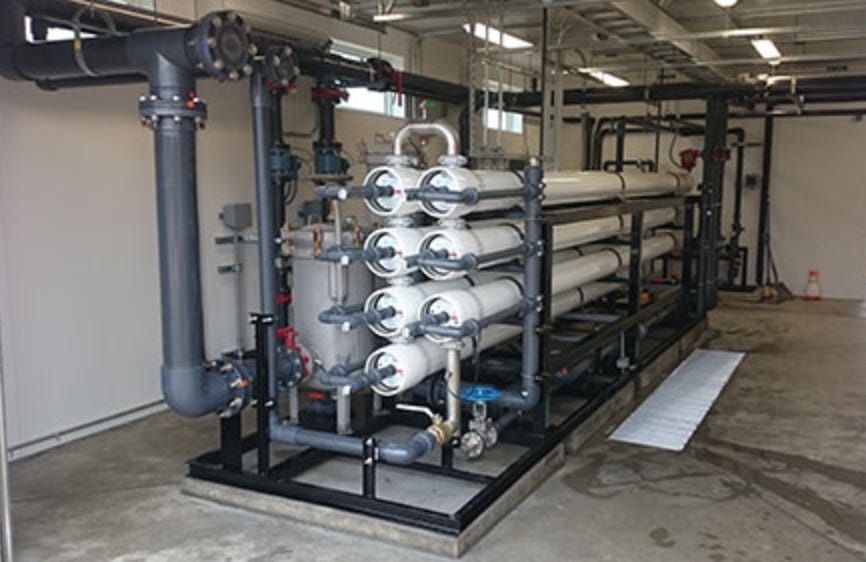
The other thing that came up last week was an observation by a Hinesburg town official to The Record about Well 4: For the last decade, 80 percent of the town’s water goes through a “nano-filtration” system designed to soften the water but that also has the capacity to filter out many types of PFAS, pesticides and other minerals should they be present, according to the company that installed the system in 2015.
This last item was a bit of a surprise. In all the public meetings by the school board, town boards and commissions and meetings of opponents, there has been no mention made of the filtration system already installed at Hinesburg’s Well 4 and which will also be installed at Well 6, a backup supply coming online sometime in early winter.
The Record reached out to the ISI Water of St. George, the firm that installed Hinesburg’s “nano-filtration” system in 2015 at a cost of about $185,000. Hinesburg’s Scott Shumway, who heads the company, was traveling on Friday but gave this response in an email:
“PFAS is a general term for a host of different types of ‘polyfluoro’ molecules. Some are long-chained, some shorter. …[It is] correct [that] the nano-filtration system was installed to reduce hardness, but it has additional beneficial properties to reject other chemicals such as pesticides, herbicides and PFAS in various percentages depending on the specific chemical.”
Here’s what it looks like:
Does this mean Hinesburg shouldn’t worry?
That’s up to the eye of the beholder.
Regarding Hinesburg’s nano-filtration system, it only filters 80 percent of the water coming out of the well (the other 20 percent goes directly into the drinking water) because filtering it all – primarily for calcium and magnesium – would make the water too soft. So if the water were contaminated, the present filtration system would miss some.
Kyla Bennett, a leading expert in PFAS contamination and filtration systems expressed doubt that Hinesburg’s system could filter out all PFAS, noting that the PFAS filtration system in her community of Easton, Massachusetts, cost $11.4 million and $1 million a year to replace the filters. The filtration system is necessary, she noted, because her town’s water supply was contaminated with PFAS in part by two artificial turf fields in her community and by repeated aerial spraying of a pesticide that contained PFAS. She noted that it is very difficult to determine where PFAS contamination originates though she noted that the two highest readings were near the two fields.
Waite Heindel said it did not examine Hinesburg’s water system or filtration system because it was not part of the charge given the firm when they were hired by the district. The spokesman could not say specifically what the firm was asked to study.
The firm does conclude, however, that in a worst-case scenario, if all of the PFAS present in the field were to leach out every day for 27 days, the quantity still wouldn’t be sufficient to be detectable once it reached Well 4.
But Bennett argues that just because PFAS is not detectable does not mean that it’s safe. All PFAS are dangerous, she said.
The question.
So is the study and the Well 4 filtration system sufficient enough for the CVSD board to move forward on the project? That is the question the CVSD board will discuss at its meeting on Tuesday after a Waite Heindel representative formally presents the firm’s study.
When The Record asked Lesser-Goldsmith for a comment about the study, he responded a day after publication of The Record’s story that summarized the study:
“Great article! Nice to see that the report definitively shows The Community Field Project has only spread facts and truth this entire time. Everything we have said about PFAS, stormwater and the groundwater of Hinesburg has been proven true in this report.
“This report should finally put to rest all the lies and misinformation that have spread about this project for over a year, including by your publication. ...”
It is very unlikely that the report will put to rest the concerns of some Hinesburg residents and government leaders.
A primary concern is the actual composition of the artificial field itself – both its top layer and the infill material below. The Hinesburg Planning Commission became the latest public entity to request an independent analysis of the materials, something that in April a spokesman for FieldTurf – the company aligned with The Community Field Project team – publicly and flatly refused to allow. (The Hinesburg selectboard, conservation commission and the Charlotte Conservation Commission have all written letters of concern to the district school board.)
Bennett, a former official and whistleblower with the U.S. Environmental Protection Agency, told The Record, “I have never seen a properly done test laboratory report showing no PFAS in artificial turf.”
Bennett, who now works for the Public Employees for Environmental Responsibility, a national nonprofit, also had several major objections to the Waite Heindel report, which she has closely reviewed. (Bennett helps municipalities and citizen groups for free as part of the work of the nonprofit she works for. She has been involved with the opponents of this project in providing her expert advice and counsel.) Her objections:
PFAS compounds are a health hazard. Period. They are transmitted by runoff into drinking water but also can be absorbed through contact and breathing.
“They (Waite and Heindel) are missing the forest through the trees; they are approaching this entire problem from a point of view, ‘Is it legal?’ They’re asking the wrong question. Repeatedly throughout the report, I see them say, ‘but this doesn’t violate water quality standards and we’re not going to see this regulated for another 10 years.’ That’s not the question. The question is: ‘Does the placement of this artificial turf in this location result in harm to human health and or the environment? And the answer is a resounding yes. Is it legal? Probably.”
“They talk about how the silt and clay soils will capture the PFAS.
That’s not true. What happens is that the silt or clay will prevent it from migrating vertically, but that just means that it runs off more easily. So actually, the thing that captures and holds PFAS is organic matter. [Yet] when you cover soil, natural soil, with plastic, artificial turf, a plastic carpet, it kills the organic matter, the organic matter dies. That means that the PFAS already in that soil, plus all the PFAs in the field, will easily leach through into the groundwater and off the site. So it’s kind of like a double whammy.”
The study does not go into the dangers of micro- and nano-plastics because there are no regulations tied to them, yet they are as dangerous and damaging as PFAS.
And storm runoff management systems are not designed to trap PFAS and micro- and nano-plastics.
Other considerations
Sometimes lost in the debate over this project – which was formally presented in mid-April – is the need.
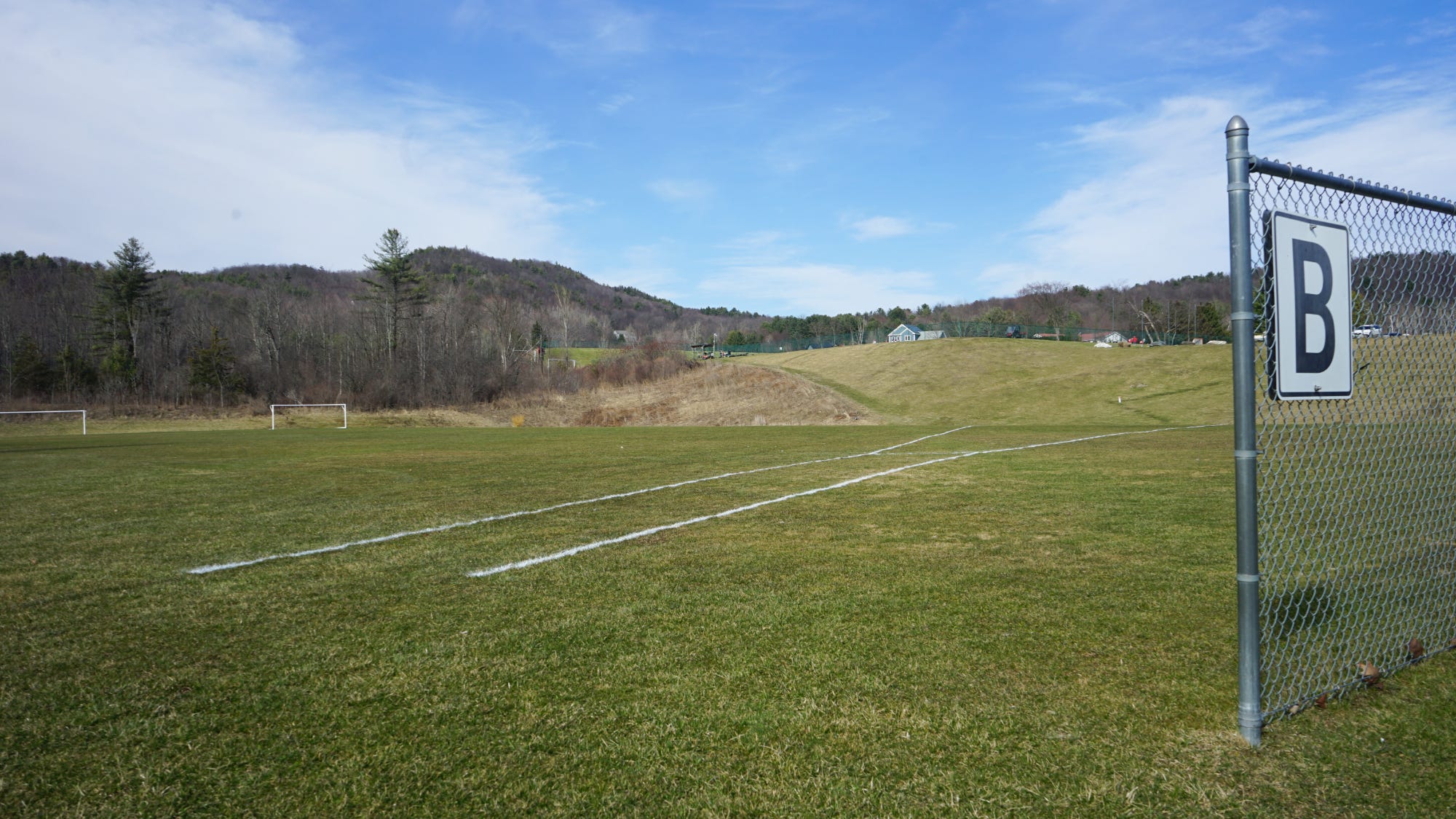
CVU’s athletic fields – which serve about 250-300 of the high school’s 1,200 students – are often problematic. Field B – the site proposed for the artificial turf and the field used for varsity soccer, lacrosse and several other sports – is unplayable after a heavy rain or in early spring or late fall. Games have to be moved to other schools’ fields, practices are moved indoors or to other facilities and playoffs cannot be held at CVU fields because they don’t meet Vermont Principals Association requirements. School officials, coaches and athletes say the poor conditions of CVU’s fields lessens the student experience and places them at a disadvantage in many games (loss of home field).
A question The Record has posed to the school and district is: “Why hasn’t Field B been improved?”
Several officials confirmed that nothing substantive has been done to improve Field B in at least 15 years because, as one official put it, “we didn’t want to invest a lot of money if it turned out we get an artificial turf field.” Twice the district asked voters in its member communities – Charlotte, Shelburne, Hinesburg, St. George and Williston – to finance a turf field, but twice – 2013 and 2015 – the voters rejected it.
A question asked by just about everyone in Hinesburg is, “why not a grass field?”
Lesser-Goldsmith says his group has considered it, but “a turf field is the best solution.” He has said repeatedly that the group is offering only a turf field – or nothing. His primary argument is that an artificial field would allow substantially more playing time than a grass field, would be less expensive to install and to maintain. An artificial field, he said, offers far more days of use – even in winter – and requires far less maintenance.
Other questions.
Deeper questions about this project have also been raised during the many public discussions of this project.
Lesser-Goldsmith has outlined a generous and heartfelt desire to create a facility that can serve far more students, “bring joy to the community” and enhance the experience of students, area sports clubs, residents and, particularly, those who physically can’t access the current fields. All noble goals. And he often adds that “thousands” of people support it.
Yet the group is not only presenting the school board a “take it or leave it” proposition, it is also saying that while the district will have “input” on decisions relating to the field’s design, engineering and construction, it will not have “veto power.” Meaning that the district has no power over or ultimate control over a $6 million project being constructed on its public property.
That presents a thornier issue for the school district board: Are they to accept a gift that gives them no real say?
Lesser-Goldsmith has said that if the board moves forward, his group will handle and pay for the entire permitting process with the state and the town of Hinesburg. The Record could not find an example of a private entity representing a public school district in a project’s permitting process before Vermont’s Act 250 review board, the Agency of Natural Resources, or the Hinesburg Development Review Board, to name a few.
Again, it seems an unusual and awkward arrangement that the district would be relying on a private group to go through the process of permitting.
And what if something goes wrong?
Lesser-Goldsmith had said that FieldTurf has agreed to “indemnify” the district from damages from its product, yet that agreement has not been made public. What if the company goes out of business? And what to make of the firm’s 2024 multi-million-dollar settlement of a civil suit brought by numerous municipalities charging defective materials in an earlier iteration of its artificial turf product?
And if the district is to enter a memorandum of understanding with the group, will that document be made public and will the details be known by the school board before they make a final vote to accept or reject the gift?
More questions.
If you’ve been following this issue and The Record’s coverage, you’ll note that school board members, Hinesburg leaders and citizens and opponents – even the Charlotte Conservation Commission of which Lesser-Goldsmith is a member – have posed many other questions related to the project’s proposal:
Are artificial turf fields safe for the athletes? Temperatures on the field are 30 degrees warmer than the air temperature, making it impossible to safely use the fields on hot days. While there are apparently no comprehensive studies of high school athlete injuries on artificial turf, there must be a reason that so many professional teams that play on fields forbid or discourage use of artificial turf.
The Icahn School of Medicine at Mount Sinai “strongly discourages the installation of artificial turf playing surfaces and fields due to the uncertainties surrounding the safety of these products and the potential for dangerous heat and chemical exposures. In addition, recent studies demonstrating the presence of PFAS and microplastics in these products raise significant concerns for both human health and environmental contamination.”
And how serious are concerns about the airborne micro- and nano-plastics that everyone agrees occur as the field gets older? According to Bennett, the concerns are extremely serious.
Estimates have been made of potential income from the field of between $50,000 (the CVSD’s number) and $80,000 a year. Is that net of costs of maintenance and staffing needed for paid events? And is that enough to offset the cost of replacing the top layer of the field within eight to 10 years?
Should the town of Hinesburg conduct its own independent study of the potential of contamination of its water from the project?
Should there be an independent cost analysis study of creating a top-notch grass field that would a) provide student athletes and area sports clubs more field time, b) be engineered to comply with requirements for tournaments and playoffs, and c) allow the town of Hinesburg to embrace the project more willingly?
Given that in 2024, the district cut $9 million and 82 positions from its 2025 fiscal year budget to get its budget passed, what does it say about the district’s priorities that it’s willing to accept $6 million for an athletic field complex?
If the school district’s stated goal is to make a decision that does not bring disharmony in the towns, what will it mean if the board goes ahead and votes to accept the gift just two months, and two public meetings, after it is formally presented?
And what a number of people have asked these past two and a half months: What’s the rush?
Geoffrey Gevalt is editor of The Hinesburg Record.
Excellent review of a very complex situation. Thank you.