

SPECIAL REPORT: CVSD board takes a stance on budget: $107m and 'level service'
Board gives preliminary support to a FY2027 budget with a five percent increase: a budget that will keep four unfilled positions open but will allow for maintaining current quality in coming year.
By Geoffrey Gevalt
Record Managing Editor
On Dec. 5, CVSD Superintendent Adam Bunting sent The Weekly Record a Letter to the Editor in sharp reaction to comments made by Gov. Phil Scott and other Republican leaders about the state’s education quality and funding.
Here’s what Scott said: “In the last five years alone, property taxes have increased by over 40 percent with fewer kids in our schools, fewer opportunities in the classroom, and more inequities from town to town. … The choice before lawmakers in 2026 is clear. … We can continue to work together to keep moving forward with our plan or they can explain to their constituents why double-digit tax increases are acceptable while inequality grows from region to region and test scores plummet.”
The context of Scott’s remarks were two things:
a committee tasked to develop a plan to consolidate Vermont’s 119 school districts into a dozen or so super-districts instead issued a recommendation that consolidation should be voluntary; and
the state education department estimated that based on early examination of preliminary school budgets Vermonters could expect their education tax bill to jump nearly 12 percent.
Scott was angry. And he called for districts to act now and for the legislature to work with him to consolidate the districts and reform funding.
What Bunting took issue with was not consolidation – the CVSD board had already said it was big enough, thank you; nor was it Scott’s call to districts to take action. Nor was he objecting to the statewide school funding plan; last year’s budget increase brought a decrease in property taxes.
What he objection to was the brush that Gov. Scott was painting his school district with in terms of fiscal responsibility and student performance.
“In the past two fiscal years, CVSD has reduced our budget by $9 million and 82 positions,” Bunting wrote. “While I acknowledge challenges in our education funding system, I don’t want to see resources for our students and a budget that you have long supported jeopardized based on hyperbole that is, at minimum, untrue for our district.
“I worry that narratives like those offered by Senator Beck, Rep. McCoy, and Governor Scott misrepresent the success and hard work of our students, educators, and families, risking support for our system.”
If you read the rest of the letter you’ll see that Bunting makes his case that CVSD’s educators, administrators and students are doing well: the students are testing better than the state averages and are showing – through a variety of other measures and surveys – increased student interest, engagement and happiness, all necessary ingredients to learning and developing. And he used numbers to establish that CVSD – the state’s largest school district – did much better than the Vermont average performance.
“While we (CVSD) have not always highlighted our standardized-test successes (in part because test scores are such a narrow definition of meaningful learning, citizenship, and human development),” Bunting wrote, “it is important to understand that statewide NAEP (National Assessment of Educational Progress) data does not represent CVSD performance. … A few points of celebration:
“87 percent of CVSD third graders were proficient or above in literacy on the 2025 spring i-Ready assessment; 70 percent were proficient or above in math.
“On VTCAP, 75 percent of our 4th graders were proficient or above in literacy and 61 percent in math.
“Our 7th graders performed especially well: 83 percent were proficient or above on the VTCAP ELA assessment.
“On the SAT (which we provide to all students at no cost), 87 percent of CVSD students last year were proficient or above in literacy.”


Bunting and his staff are, in essence, making the same case with the CVSD board that they will eventually have to also make to voters: CVSD must have a “level-service” FY2027 budget to continue to offer what they are offering the students.
The board concurred and supports the $107 million figure. As board chair Meghan Metzler put it: “I know that’s a very large ask of our communities,” but it is necessary.
Board member Keith Roberts put it this way: “In light of what we’ve done over the last couple of years, I am very, very hesitant to push much more. … As a member of this board and prior boards I have felt some responsibility to control the education funding in this state by my local actions. I believe I have, and the boards I have served on have, done our part in this.”
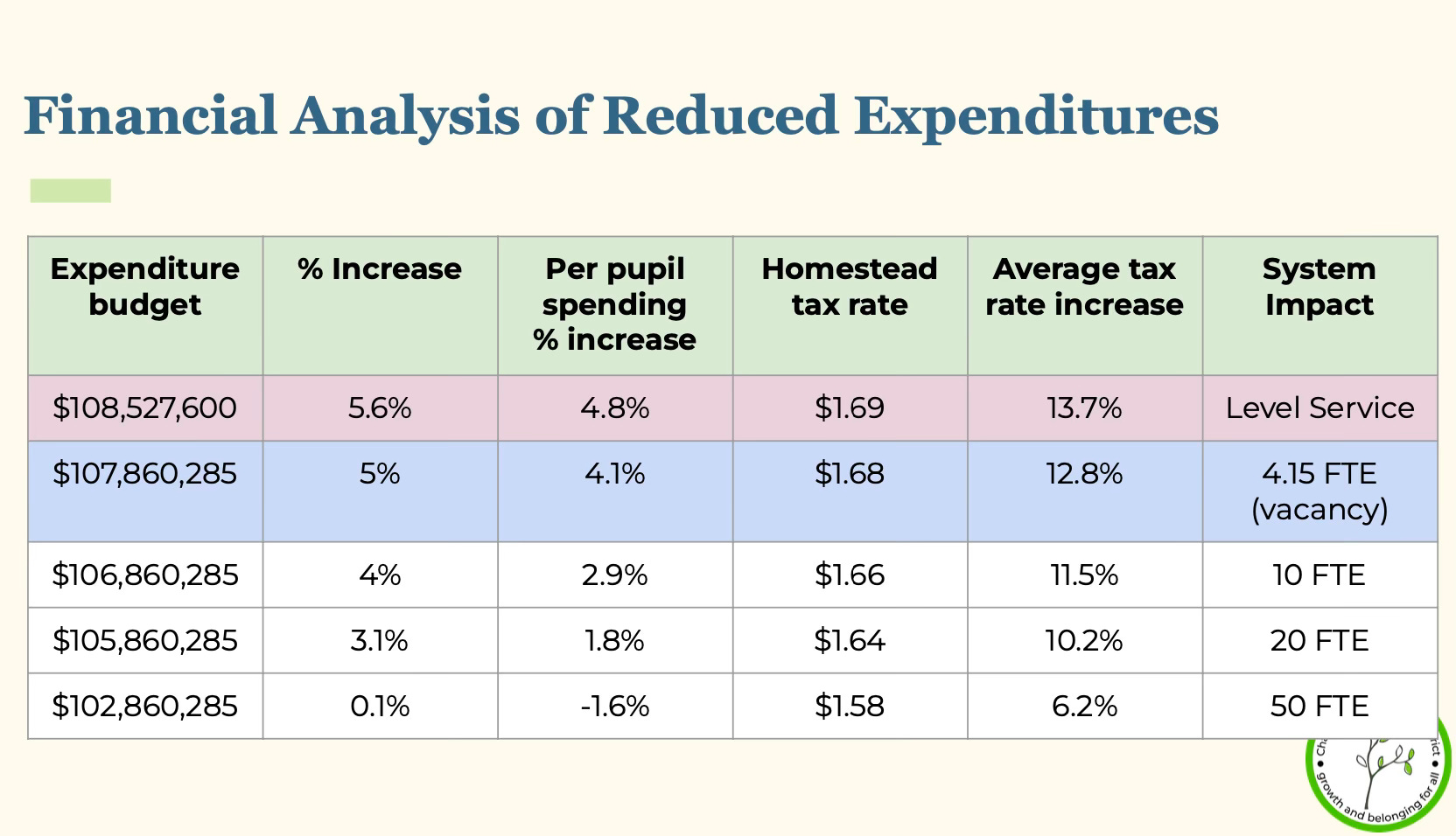
In a conversation with The Record after the meeting, Bunting and the district’s chief operation officer, Gary Marckres, analyzed the budget as it stands now.
Much of the district’s budget is locked in: most of the increase comes from a 7.3 percent hike in teacher healthcare costs (all teachers are part of a statewide negotiated plan) and an approximate five percent salary increase which is part of the three-year, 15 percent increase in salaries the teachers negotiated with the district board earlier this year.
Special Education
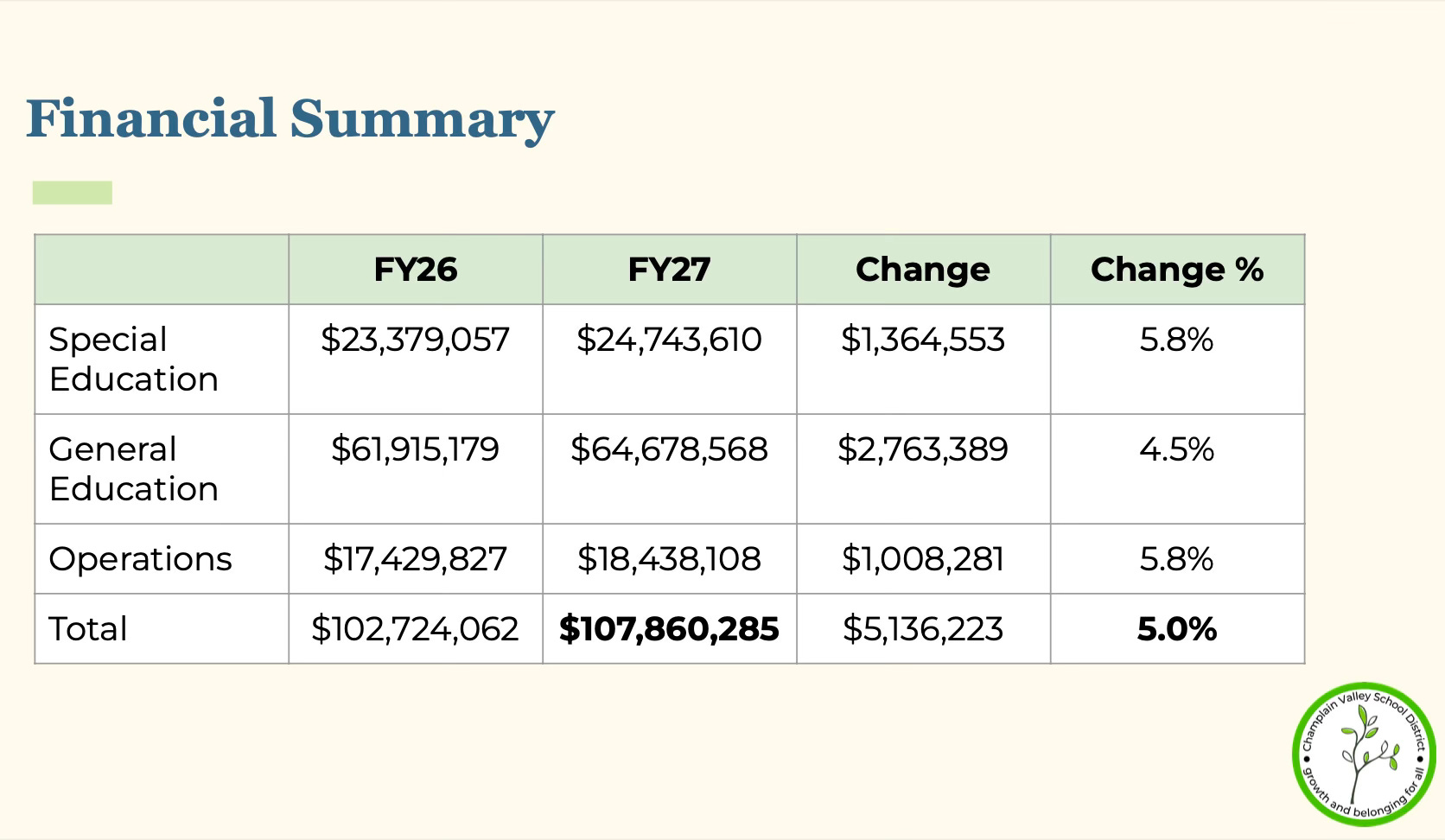
As the chart above shows, special education costs are going up nearly six percent and represent nearly 25 percent of the budget, yet special education students represent less than 15 percent of the total enrollment.
It is time for an introduction to what is known as “weighted students.” Without getting technical, essentially there is the straight body count of students estimated to be 3,530 vs. 3,578 this year; and this decline has been going on for several years, just as it has statewide; Gov. Scott is right about that.
But CVSD has seen a rise in the number of “weighted students” – students who are economically disadvantaged; English-language learners and/or receiving special education services; and/or who have had limited or interrupted formal education. Because these students require more staffing and support, the reimbursements from the state are higher.
And, to be clear, it is the district’s obligation to serve these children.
About the state’s numbers
The easiest way to understand how schools get funded in Vermont is to get yourself a PhD. Barring that, the simplest thing to remember is that right now – and even when you go to vote in March – no one will know exactly how much you will end up paying in education property taxes based on that budget.
That’s because it takes a kind of volley of information back and forth between the districts and the state education department, with the Governor’s office and Legislature jumping in as needed, before anyone knows a) the total amount of spending Vermont voters approved in their local districts, and b) what tax rate each community will have to set to raise the amount required to pay for its share of the district’s costs.
But there are a few more curveballs that make that previous statement look simplistic. (It is.) Because a big unknown in all this is what state political leaders will do. Last year, they moved $120 million from elsewhere in the budget – money ostensibly for other state services – and reapplied it to education as a way to ”buy down” the expected bump in tax rates.
As a result, while last year’s approved CVSD budget showed an increase of about one percent over the previous year on a cash basis, the education property tax rate for the CVSD communities actually went down at least by 3.8 percent in large part due to the “buy down.”
So while the district’s current FY2027 budget shows a five percent increase in dollars over last year’s budget, that doesn’t necessarily mean that Hinesburg’s tax rate is going up by a like amount.
Bunting and Marckres aren’t sure a “buy down” – using state funds from other areas to pay for the costs of education – is going to happen this year, though they do expect the overall tax hike to be much lower. “Historically it always goes down,” said Marckres. However, Gov. Scott has already acknowledged that his office “is exploring” another “buy down” to put in the FY2027 state budget he is preparing to present to the Legislature in January.
Whatever happens later this year – after we vote – can’t be foreseen. What we can do is study the current district budget and understand why the administration and board believe that $107 million is absolutely needed to maintain the services; in other words, to maintain improvements in student performance across many benchmarks.
Drawing a line in the sand
At its meeting on Dec. 9, board chair Metzler acknowledged, after asking other board members whether they favored the $107 million budget, that all of them will need to support it and to tell people about why it is needed.
Bunting acknowledged the vital need to get the word out, and get people interested and engaged.
But getting the residents to engage in the budget process has always been an issue: school budget meetings have historically been scantily attended. The district is hoping for better this year and plan various ways to reach out. And important meetings lie ahead:
This Tuesday, Dec. 16, the board will meet at 6 p.m. at the CVU library to discuss the operations and maintenance budgets and the $13 million bond issue the district is also going to seek to pay for various repairs and upgrades throughout many of the school buildings.
On Jan. 13, 2026, again at 6 p.m. at the CVU library, the board will discuss revenue projections and tax implications.
The following week, Jan. 20, 2026, same time, same place, it will approve and warn its final budget.
Tough environment
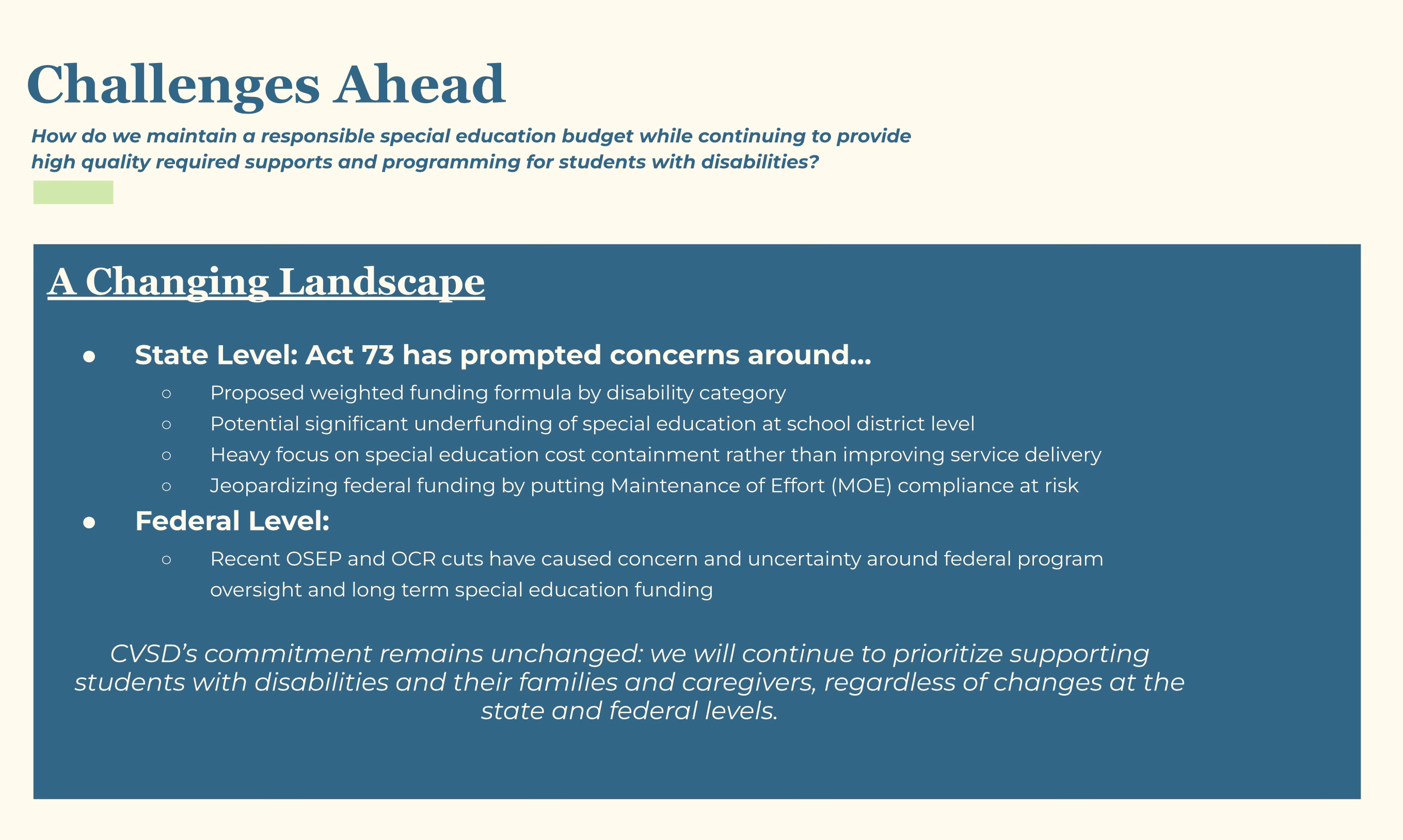
So CVSD has a task ahead of it: to convince the voters in Hinesburg, Williston, St. George, Charlotte and Shelburne that the budget – and estimated tax rate hikes – are worth it. It begs the question: Are our schools worth it?
The district is answering an emphatic ‘yes.’ The board and administration are saying, essentially: ‘Our benchmarks indicate we are doing a good job, the students are improving, and we’ve recovered from cuts made two years ago. A level service budget of $107 million with a five percent increase is what is needed to best serve the students of the district.’
In Hinesburg, this is a familiar tune. Other major town departments are asking for large increases and say their requests are absolutely needed to ensure safety and professional service:
The Hinesburg Fire Department is seeking a 36 percent increase to pay for two additional firefighters he says are needed to make the community safe; Chief, Prescott Nadeau, is making a big and public push for this saying it will benefit the town and is absolutely necessary.
Interim Police Chief Frank Bryan has proposed a 21 percent increase but notes this is essentially to return to levels of several years ago – six full-time officers, including the chief.. To do less, he says, will jeopardize the future of the police department now only capable of covering the community 60 hours of a 168-hour week.
And Town Clerk/Treasurer Heather Roberts is seeking a new position to cope with all of the duties of her office, responsibilities that took her nearly two minutes to list when she presented her budget to the town selectboard; she also said the extra position will allow her office to finally get to projects to improve the record-keeping systems.
All this is up against a backdrop of a reappraisal, rising costs for everything from fuel to furniture, food to fun, childcare to medical care. Residents are feeling the pinch. Town leaders are leery of increasing the tax rate.
Looming in the near future in Hinesburg will be a dramatic increase in housing which will, yes, expand the tax base but also bring more residents with more demands on town and school services.
That certainly has been on the minds of the people proposing these increases while, at the same time, saying, in essence: ‘This is what we need now to do our jobs well.’
And it seems people are interested: Bunting’s letter had been read on our website 1,215 times at last account. Our posting of it on our Facebook page has been viewed 33,275 times, boosted by 33 shares, 66 comments (not all lovely) and 266 likes. The interest and support are out there. This we know.
Missippi spends $12,500 per student compared to our $29,000 and their students outperform ours on standardized test scores. Huston we have a problem which maybe the incompetent legislature should look at what states are doing that don't pay exorbitant prices for lower outcome.