

CVSD FY2027 Budget Finalized – Tax Increases May Be on the Way ...
Or perhaps not. The final tax impact won't be known until spring after the state makes several decisions and all Vermont school budgets are in. Do you support the budget? Take poll at bottom of story.
The Record Staff
Here’s a number to remember: $64.10.
Here’s a number to forget: $64.10.
Remember that number because that’s the amount Hinesburg taxes are estimated to increase – $64.10 per $100,000 of assessed property value – to pay for the increase in the Champlain Valley School District schools budget next year.
Forget the number because it mostly likely will change – well after you vote on March 3 (or before).
The final impact of the schools budget depends on:
whether the governor and Vermont Legislature decide to allocate a separate “buy-down” expenditure to reduce property tax rates and, if so, how much that expenditure will be;
the total of all approved Vermont school budgets, which will affect how the state education fund is divvied up; and
whether your household has income less than $115,400, in which case you may be eligible for a property tax credit.
And those three things won’t be known until sometime in late April or early May – after you vote on March 3 (early voting begins in mid-February).
So, for the moment, keep $64.10 in mind because that’s what CVSD figures will be needed for Hinesburg’s share of the increase next year. As it stands (final vote by the CVSD board on Jan. 20), the total budget stands at $107,860,285 – a five percent increase over this year’s budget.
And, by the way, the recent reassessment of property values reveals the disparity in rates with the other towns.
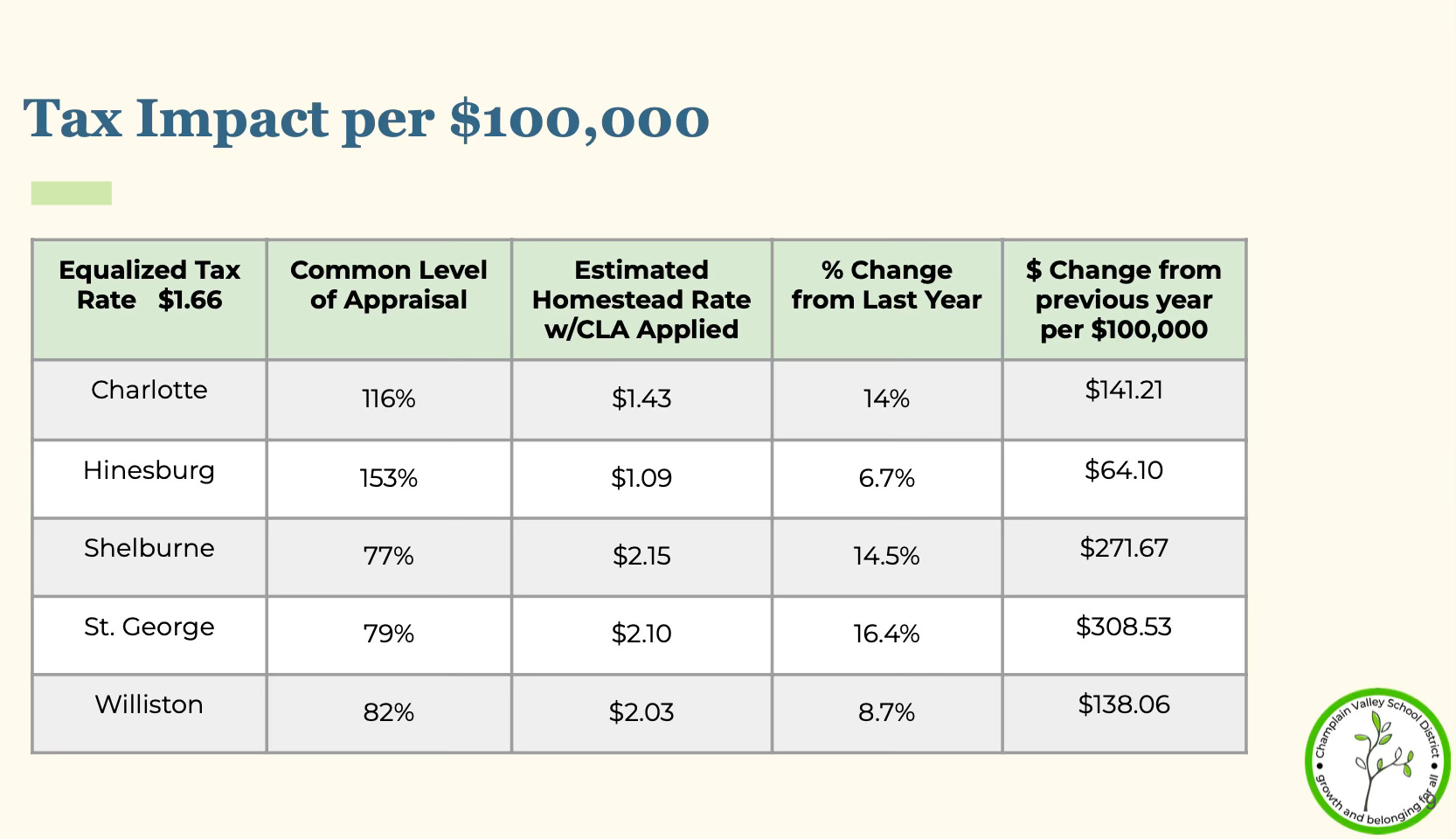
All of which raises two questions: 1) Why is Vermont school funding so dang complicated? and 2) how can we vote for something when all the facts aren’t known?
The answer to the first question probably can’t be answered. However, for the second question consider these points:
Since the initial rejection of the initial FY2025 budget (March 2024) the CVSD has cut 82 positions and $9 million;
The school board considers that the $107 million budget is a “level service” budget, meaning the schools will offer the same “services” as last year;
Much of the $5.1 million increase is beyond the district’s control: $3.1 million goes for negotiated raises for teachers and other staff; $721,000 is for increased healthcare costs; and
The number of “weighted pupils” has gone up, so the reimbursement from the state will go up. (Weighted students are figured by a complex formula that brings in the higher costs of working with special education students and students from low-income families.) And, on a weighted student basis, the budget is only 2.7 percent higher.
All of this was outlined by Gary Marckres, the district’s chief operating officer, to the board on Tuesday, Jan. 13. To see all of the numbers in Marckres’ charts click the pdf below to either download or view:

For a Special Report on the CVSD School Budget, click here.
Board chair Meghan Metzler of Charlotte had this reaction: “We think that it’s a responsible budget that reflects the needs of our students. … And that 2.7 percent increase per pupil is quite astounding in order to continue to provide the services we know are so important to the students.”
Only one individual – a teacher – addressed the board and he thanked the board for its efforts but reminded them of the impact each year of potential cuts.
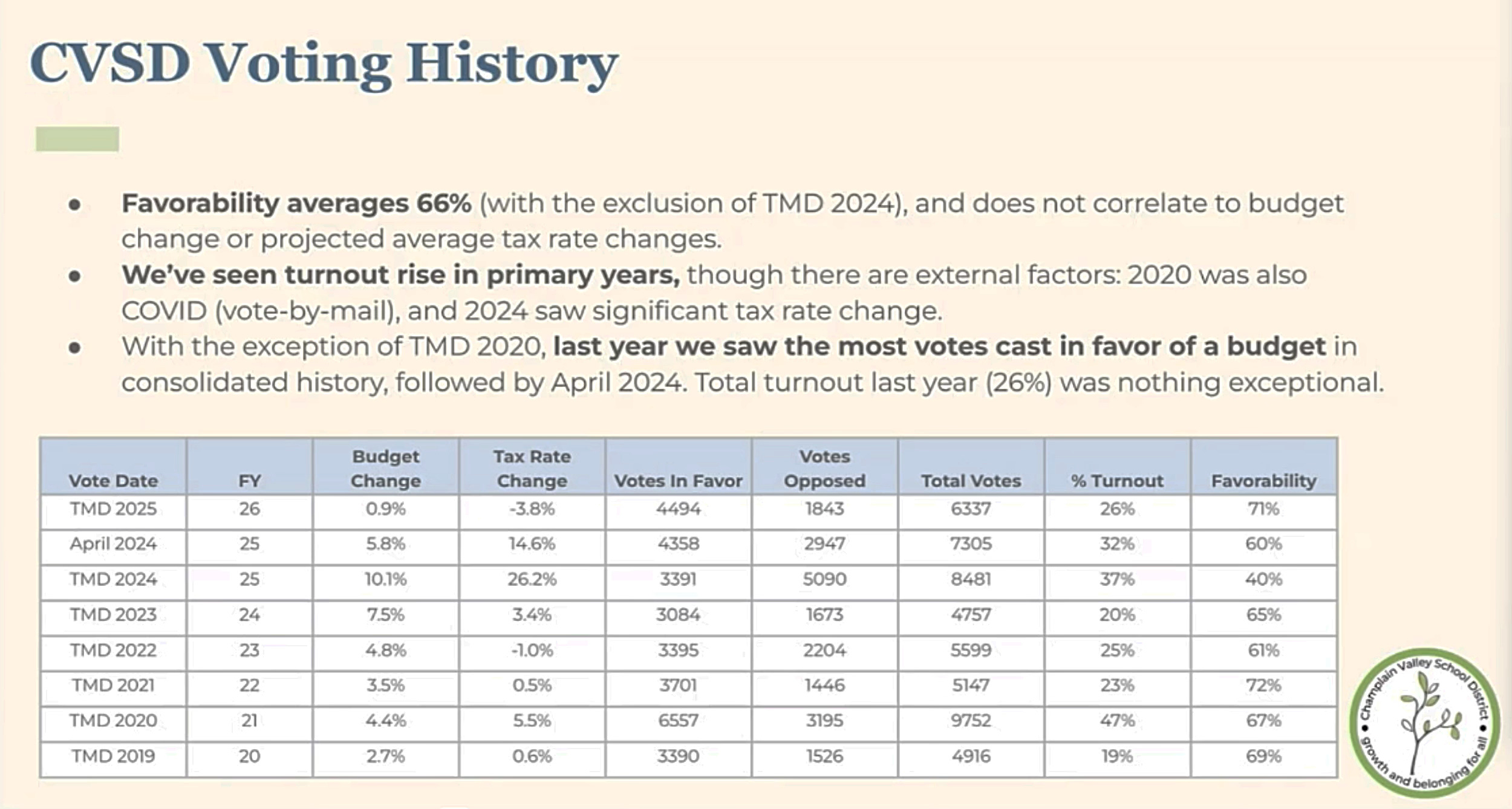
The meeting then shifted to plans to inform the public and make the best case for the budget’s approval. Tyler Cohen, communications director for the district, outlined a broad plan for media, social media, informational meetings and videos. One of the first things he noted in his presentation was how there weren’t any correlations between the size of the budget increase and approval. Further, he noted that turnout also didn’t relate to major increases in the budget:
Superintendent Adam Bunting outlined an emphasis in the communications strategy:
“We are leaning more heavily into CVSD being a strong system, partly to counter the narrative that’s been coming from the state about how the entire educational system is funding. We are proud of what we put forward for our students, that we are invested in our students’ outcomes.
“Not to say we don’t have areas of growth … but we’re combatting a narrative that is misleading.”
To read Bunting’s full views about statements the governor and legislative leaders have made about Vermont’s public education systems, click here to read his December commentary in The Record .
Also raised at the meeting was problems the district is having with its six electric vans. Marckres said that while he was the one who pushed the idea last year to lease these vans, they’ve been having a lot of problems, particularly in the cold. As a result, he asked the board to approve an additional item on the ballot: A bond vote for $250,000 for two buses and two mini-buses. He added that demand for the smaller vehicles was extremely high.
That bond vote would be over and above a $13 million bond to fund a variety of maintenance projects at most of the district’s schools.
NOTE: Take The Record’s straw poll about the budget. You must be subscribed and signed in to vote. (Click ‘Sign in’ in upper right corner and follow instructions.)