

Several CVSD Board Members to Speak About Turf Vote
No agenda item on CVU turf field project, but Hinesburg's board representatives will share their reasoning for supporting the turf field proposal.
News Analysis
By Geoffrey Gevalt
Hinesburg Record staff reporter
The turf field is not on the CVSD board’s meeting agenda this week. But when it meets at 6 p.m. on Aug. 18 at CVU library (Zoom link here), Hinesburg’s two representatives are expected to explain their support for the project.
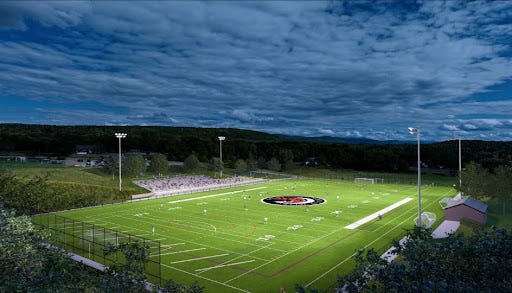
On June 30, the school board voted 8-3 (with one abstention) to enter into an agreement with Friends of CVU and a group led by Eli Lesser-Goldsmith to accept their offer of a $6 million privately financed artificial turf field, stands, lighting, concession stand, ADA access and additional parking at Field B behind CVU.
The aim of the group is to deal with a long-standing problem that the existing grass fields are unplayable for a good part of the spring and late fall and are not deemed suitable for playoffs by the Vermont Principals’ Association (VPA).
Shortly after the vote, The Record emailed each of the board members in an attempt to get their perspectives behind their votes. Two accepted our offer – chair Meghan Metzler and vice-chair David Connery – one declined, six didn’t respond and Hinesburg’s two members – Keith Roberts and Cassandra Townshend – said they planned to give statements on the issue at this week’s board meeting.
The issue, of course, is the potential for artificial turf to contaminate well-water and adversely affect health of athletes, concerns voiced by hundreds of Hinesburg residents, the Hinesburg selectboard and several other boards and commissions, including the Charlotte Conservation Board on which Lesser-Goldsmith serves.
The breadth of the opposition was unexpected. Many opposed artificial turf and asked, “Why not a grass field?” Many also objected to the seeming fast pace of the board’s decision.
What most people didn’t know – and found out from documents released after the board’s vote – was that the proposal had been quietly discussed for over a year and a half between Lesser-Goldsmith’s group, CVU and district officials, and school parents and students before it was formally presented to the public in April. By then, the project had garnered considerable support and excitement within the school community.
The board, in response to expressed environmental concerns, authorized the district to pay $10,000 for a study by a Burlington hydrogeologist that found it was “highly unlikely” the fields would contaminate the town’s and nearby citizens’ wells.
The report satisfied the majority of the board. The opposition found the study lacking in many respects.
On July 15, 2026, the district signed a gift agreement (copy below) with Lesser-Goldsmith – representing his group, The Community Field Project – and the project’s fiscal agent, Friends of CVU. It is now up to the group to raise the money so the project can move forward. The group has repeatedly said the project – including the costs of permitting – will be provided at no cost to the district.
Since then
Much has happened since the board’s decision on June 30:
The district released the gift agreement to the public. (A copy is below.)
Aspects of the memorandum – and the board votes on June 30 – were then called into question by a lawyer representing Responsible Growth Hinesburg and a handful of Hinesburg citizens. The district’s lawyers responded that the district complied with Vermont’s Open Meeting Law.
Within the gift agreement was reference to a “term sheet” – a kind of preliminary agreement – the district signed with the group on Aug. 13, 2025 (copy below).
This previously undisclosed agreement was the source of consternation among many who felt that the district had not been transparent enough.
A video of the Aug. 12, 2025, CVSD board meeting shows that Lesser-Goldsmith made a brief presentation of his group’s proposal. A board member asked how the board could help, and he asked that he be given time to line things up before the board publicized it.
Discussion in the meeting also revealed, and school officials later confirmed, that discussions between Lesser-Goldsmith and CVU and the district had begun in the fall of 2024.
On Aug. 5, Supt. Adam Bunting appeared at the Hinesburg selectboard meeting and gave a statement (copy below) in an attempt to assuage the opposition, a move that several in attendance said they appreciated.
The next step for the Community Field Project group is to raise the money and Lesser-Goldsmith, while acknowledging that raising money is always challenging, has continually said that “thousands” of people support the project. Lesser-Goldsmith declined to comment on the group’s next steps.
Two sides to the issue
There are three areas of concern among hundreds of Hinesburg residents:
Opponents and numerous board and commissions are concerned that chemical runoff from the field will harm groundwater and that micro plastics dispersed in the air as the field degrades will harm athletes’ and neighbors’ health.
Lesser-Goldsmith has stated numerous times that the artificial field will be “100 percent PFAS-free,” yet no one can really say that unless all materials are tested. And even then conventional tests look for only a small number of the estimated 15,000 PFAS compounds that could be present in artificial fields.
What Lesser-Goldsmith may be able to say down the road is that the field and manufacturer chosen by the district has certified its product will be free of PFAS (forever chemicals) “intentionally added” in the manufacturing process and thus will be in compliance with state law.
Opposition centers, in part, to the fact that state regulations don’t go far enough. Lesser-Goldsmith rightfully argues that those concerns should be taken up with the state Legislature, not with his project.
As background, Hinesburg is coping with two water contamination issues: One of its wells had to be retired after it was discovered that chemicals leaching from the old gas tanks in front of Lantman’s had contaminated the town’s well. And downhill from the old town dump, wells of several homes have been contaminated and the town is paying upwards of $50,000 a year to filter the homeowners’ water.
It was also learned that the filtration system installed on Hinesburg’s Well 4 and the one being installed on Well 5 (to be in operation late this fall) are able to filter PFAS, according to the company that installed it.
But the other side of the issue is also powerful.
For years, CVU’s grass fields have been unplayable because of Vermont’s weather, particularly in the early spring (snow), late spring (rain) and late fall (rain and snow). Further, because of the fields’ unpredictable conditions, lack of ADA access and no fencing on Field B – the main field – CVU cannot host playoff games in several field sports. And many “home” games have to be moved to other venues.
More importantly, the project’s supporters say, the 250-300 CVU athletes using the current fields don’t get the full experience of working as a team on the field; often they are shuttled to artificial fields at other high schools or at UVM to play games or practice or go indoors. The proponents also argue that as the largest high school in the state, it deserves commensurate facilities.
Board members’ thoughts
So far there has been little explanation from the individual CVSD board members as to why they voted the way they did. In fact, during the June 30 meeting, there was little discussion of the issue by board members.
However, a few have made their positions clear to The Record.
Board chair Metzler sat down with The Record and was succinct in explaining her decision to abstain: “My vote wasn’t needed.” She declined to say what her vote would have been if it had been necessary to decide the issue. She went on to explain her perspective on the issue and the June 30 meeting, which grew contentious.
Shortly after her interview with The Record, she issued a public statement which said, in part, “The decision was not made lightly or quickly. It followed months of community input and deliberation, along with a sincere effort to balance student safety and opportunity, environmental responsibility, community concerns, and the evidence available to us – a process we should have better explained to the public on June 30.
“The board has wrestled with both the potential benefits of the gift and its possible unintended consequences,” she added in her statement. “We understood from the beginning that our first responsibility was to the safety of our students and broader community and that any decision would also have implications for the trust we have worked to build with our communities over many years.
“We did not fully see just how polarizing this proposal would become. But it did.”
Dave Connery, the Shelburne representative and vice chair, was one of three to oppose the project. He spoke with The Record last month and made clear he was speaking for himself, not for the board.
“The heart of [my opposition] was in two of the last three years we’ve cut a total of $9 million from our budget and 82 full-time staff equivalents. … We have a lot of financial uncertainty [ahead], and I don’t think this is where we should be spending our energy, and I don’t really think it’s a necessary thing that we need in the district.”
He said the letters the district received were “pretty split. … We had supportive parents; I had students in the school sending me notes who were talking about games that were cancelled. … And then I had voting residents … presenting their case for safety and [opposing] for environmental reasons and potential budgetary reasons.”
Connery shared some of those environmental concerns saying “it’s really difficult” to know what the environmental impacts can be “because … the science and regulation is trying to keep up with what the reality is. And we’re trying to do objective analyses of these things, and it’s so hard because things are evolving so quickly.
“But things that are more objective are budgetary challenges and the things we should be concentrating on in the school … I guess I was kind of frustrated with all the work we’ve put in over the last three years on the budget and all the issues that are coming up with education finance, it just felt like, to me personally, this turf field issue required way more energy and put way more negative energy into the room that we haven’t felt in many years and really just sort of derailed us from our core focus.”
What’s next?
In the June 30 board meeting, Rep. Angela Arsenault, a former member of the district school board, said over Zoom, “I just want to speak to the wisdom of opening the district up to what is all but guaranteed to be litigation. So at a time when public trust in our district is more important than ever, I really caution the board and hope you’ll consider voting no.”
The first steps in this legal opposition began when Bristol lawyer James Dumont, representing Responsible Growth Hinesburg and a group of Hinesburg residents, challenged the way the board went about its decisions, arguing that their votes violated Vermont Open Meeting Law. The board’s attorneys promptly dismissed the argument and said the board acted lawfully. Whether the groups take more substantive legal action remains to be seen.
Assuming the turf group raises the estimated $6 million needed and the project moves forward, it will have to navigate a complex set of permits with the state and the town of Hinesburg for the storm runoff, lighting, grandstands, etc.
It would be expected that opponents will apply for status in those permit hearings and that could complicate an already complicated process.
In his statement to the selectboard, Bunting said this:
“The discussion thus far has remained civil and focused on the challenge before us: how to balance opportunity with environmental safety. Of the hundreds who have reached out to the board, most have acknowledged that people on both sides of this issue are trying to do right by their community. … There have been good points and good questions on all sides.
“Playing on grass is wonderful. But even the most expensive, well-designed and well-maintained grass fields do not provide the same durability as turf, particularly during Vermont’s wet and muddy seasons. Turf allows for multiple events in the same day, repeated use throughout the week, and a longer, more dependable season. In addition, modern turf can be safer than fields that are muddy, uneven, or otherwise inconsistent.
“At its core, we are considering this proposal because of the possibility of creating more and safer opportunities for students and a meaningful gathering place for the broader community.
“So how do we move forward?
“To me, this is a question of reasonableness. Taking a ‘never turf’ position simply because the word turf is involved does not feel reasonable. As a country, we make things safer through public pressure, regulation, and better manufacturing standards. During the leaded gasoline debate, for example, we did not ban gasoline altogether. We required a safer environmental tradeoff.
“Vermont has taken meaningful legislative action to restrict PFAS in turf fields and other products. As we consider how to move forward, we will need to ensure that any manufacturer certifies compliance with that law. If they can, then I believe it is reasonable to continue considering turf. But that needs to be demonstrated through current science and current law, not through assumptions or what used to be true.
“I know people feel strongly about this issue. That is understandable. Fields, water, health, recreation, taxes, the environment, and student opportunity all matter. My hope is that we continue to approach the conversation with curiosity, humility, and respect for one another.”
